

Gold — A Complete Market Guide (2026)
Data as of 25 June 2026. Prices are quoted as multi-year and full-year averages, not a single day’s snapshot, so this report stays useful over time. Reserves, production splits, balances, and historical series are estimates from agency data, rounded for clarity. This report is for information only and was prepared with AI assistance — see the disclaimer at the end.
Gold is the oldest monetary asset still trading every business day, and in 2024–2025 it did something unusual: it set record highs while nominal interest rates were high — a regime that normally works against it. This report is the free, big-picture primer on how the gold market actually works — where it comes from, who buys it, how its price is set, and which economic regimes favour it. For the company-level data behind the charts — every producer screened by production, reserves and cost — go to Metal Pilot .
TL;DR & Key Takeaways
- What it is: a near-indestructible precious metal that is simultaneously a monetary reserve asset, a luxury good and a minor industrial input. Almost all the gold ever mined still exists, which makes gold’s defining feature its enormous above-ground stock relative to annual flow.
- Market structure: mine supply (~3,300 t/yr) is geographically spread — no country holds more than ~12% — so there is no supply cartel. The price is set in London (LBMA) and on COMEX futures, not by producers.
- Demand story: jewellery is the largest single use, but the swing factor in 2022–2025 has been the official sector — central banks bought more than 1,000 tonnes a year for three straight years — alongside investment (bars, coins, ETFs).
- Price regime: gold is a non-yielding, dollar-priced asset. It historically does best when real interest rates fall, the dollar weakens, or confidence in financial assets breaks (inflation shocks, crises, de-dollarisation).
- Biggest swing factor: the direction of real (inflation-adjusted) interest rates and central-bank demand.
Numbers to remember (gold at a glance)
Figure 1. Gold at a glance
Figure data: USGS Mineral Commodity Summaries 2026 and World Gold Council Gold Demand Trends 2024; see Sections 2.2–2.6.
Why it matters now: gold is the textbook hedge against monetary debasement and financial-system stress, and it tends to lead when the rate cycle turns from hiking to cutting. The big-picture case is below.
How to read this guide: new to gold? Read straight through from Section 1. Here for the investment case? Jump to Section 4 — how to own it, how to screen the miners, and which regimes favour the metal. Every technical term is defined in the Vocabulary (Section 7).
1. Gold & the market basics
1.1 What gold is — physical basics & quality
Gold (chemical symbol Au) is a dense, soft, yellow metal prized for three properties that no other element combines: it is chemically inert (it does not corrode, tarnish or react with oxygen), it is scarce but divisible, and it is beautiful and easy to work. Those properties are why, for over 2,500 years, societies independently converged on gold as money and as a store of value. Today gold earns its value from four overlapping demand pools: monetary/store-of-value (central-bank reserves and investor hedging), jewellery (adornment that doubles as savings, especially in Asia), investment (bars, coins and exchange-traded funds), and a small but high-spec industrial slice (electronics, dentistry).
A few terms define gold quality and form, each used throughout this report:
- Purity / fineness — how much of a piece is pure gold, expressed as karats (24k = pure) or as fineness in parts per thousand (.999 = 99.9% pure, the standard for investment bars). Gold is weighed in the troy ounce (oz, 31.103 g — heavier than the everyday avoirdupois ounce); the full unit convention is stated in Section 1.2.
- Doré — the impure gold-silver alloy bars a mine pours on site (typically 70–90% precious metal); doré is shipped to a refinery to be upgraded to .995+ bullion.
- Ore grade — grams of gold per tonne of rock (g/t). A modern open-pit mine may run ~1 g/t; a high-grade underground mine can exceed 8–10 g/t. Grade, not the gold price alone, decides whether a deposit is economic.
- Primary vs. by-product — gold mined for its own sake (primary) versus gold recovered alongside copper or other metals (by-product); see Section 2.5.
The value chain — from ground to vault. Gold moves along one clean path: exploration → mining → milling/processing → smelting (doré) → refining (.9999 bullion) → fabrication (bars, coins, jewellery, components) → the end buyer (investors, central banks, consumers, industry). Sitting alongside that physical chain is a deep financial market — the London over-the-counter (OTC) market and COMEX futures — where far more gold changes hands on paper each day than is mined in a year.
Figure 2. The gold value chain, ground to vault
Source: industry value-chain primers; conceptual diagram.
From rock to doré — what happens inside the mill. Between “mining” and the first bar the ore runs through a fixed sequence of unit operations, and the same terms recur in every technical report. The ore is first mined — blasted and hauled from an open pit or an underground stope — then put through comminution (size reduction): a crusher breaks run-of-mine rock down to gravel, and a mill (typically a rotating SAG — semi-autogenous — mill followed by a ball mill) grinds it to a fine powder, because gold locked inside the rock has to be physically liberated before it can be extracted. The ground slurry is then concentrated and leached to get the gold out: coarse free gold is caught in gravity circuits, sulphide ores are upgraded by flotation into a concentrate, and the gold itself is dissolved by cyanide leaching — a dilute cyanide solution that selectively dissolves gold — usually run as carbon-in-leach / carbon-in-pulp (CIL/CIP), in which fine activated carbon adsorbs the dissolved gold straight out of the slurry. (Low-grade ore is instead stacked on a lined pad and heap-leached — far cheaper, but slower and with lower recovery — while sulphide-locked refractory ore must be roasted or pressure-oxidised before cyanide will work.) Finally the gold is stripped off the carbon (a hot caustic wash called elution) and plated out onto steel-wool cathodes by electrowinning; that gold-rich product is what gets melted into doré next.
Smelting vs. refining — two different steps, often confused. The mid-chain reads as one act but is really two, done in two places by two methods. Smelting happens at the mine: the gold-rich product recovered above is melted in a furnace with chemical fluxes that pull the rock and base metals off as slag, and the molten precious metal is poured into doré — impure gold-silver bars, typically 70–90% precious metal. It is a pyrometallurgical (heat-driven) step that concentrates and casts the metal but does not purify it to a tradable grade. Refining happens afterwards, at a dedicated refinery (overwhelmingly Swiss), and chemically upgrades that doré to investment-grade fineness. Two processes do the work: the Miller process bubbles chlorine gas through the molten metal to strip out base metals and silver, reaching ~99.5% (.995) quickly and cheaply, and the Wohlwill process then electro-refines the gold in an acid bath to deposit .9999 (“four-nines”) bullion onto a cathode. Put simply, smelting gets the metal out of the rock and into a bar; refining makes that bar pure enough to certify and trade.
The split is commercial, not just technical. Doré is a mine’s saleable product, but it cannot be delivered into the bullion market — only an LBMA-accredited refiner can turn it into a “Good Delivery” bar, which makes refining a concentrated, gatekept link in the chain (Switzerland alone processes well over half of newly mined and recycled gold). That is also why the trade map in Section 2.6 looks the way it does: doré flows in to a handful of refining hubs, and .9999 kilobars flow out to Asia.
1.2 Units & measurement conventions
This report uses the precious-metals convention throughout, stated here so every later number is unambiguous. Gold weight is measured in troy ounces (oz) and metric tonnes (t); one tonne = 32,151 troy ounces. For volumes we use Moz (million troy ounces) and koz (thousand troy ounces) for company and mine output, and tonnes (t) for national and global flows, mirroring the convention used by the U.S. Geological Survey (USGS) and the World Gold Council (WGC). Price is quoted in US dollars per troy ounce (USD/oz) unless stated. Grade is grams per tonne (g/t).
Crucially, gold figures split into flow and stock, and confusing the two is the single most common error in gold analysis:
- Flow — quantities per year: mine production (~3,300 t/yr), recycling (~1,370 t/yr), demand (~4,900 t/yr).
- Stock — the cumulative level that exists at a point in time: all the gold ever mined, the above-ground stock, estimated at roughly 216,000 t at the end of 2024 (WGC). Because gold is not consumed, that stock keeps growing and dwarfs annual flow — the basis of the stock-to-flow ratio (Section 2.5).
Table 1. Gold units and conversions
| Unit | Meaning | Typical magnitude in gold | Conversion |
|---|---|---|---|
| troy ounce (oz) | Standard precious-metal weight | A 1 oz coin; price quoted per oz | 31.1035 g |
| tonne (t) | Metric tonne, gold content | National/global flows | 32,150.7 oz |
| Moz | Million troy ounces | Company annual output, reserves | 31.103 t |
| koz | Thousand troy ounces | Single-mine annual output | 0.0311 t |
| g/t | Grams gold per tonne of ore | Ore grade (open-pit ~1, underground 5–10) | 1 g/t = 0.0292 oz/t |
| karat (k) | Purity in 24ths | 24k = pure; 18k = 75% gold | 24k = .999 fine |
Source: USGS Gold Statistics and Information , 2026; World Gold Council , 2025.
Numbers intuition: a large modern gold mine produces 300–800 koz/yr; a single standard “Good Delivery” bar held in London vaults weighs ~400 oz (12.4 kg); total annual mine supply (~3,300 t) is about 106 Moz, worth roughly $350 billion at recent prices — large for a metal, but small next to global bond or equity markets.
1.3 Pricing & benchmarks
There is no single “gold price”; there is a tight web of linked benchmarks, and the rule in this report is to quote averages, not a single day’s snapshot. The two reference points that matter most are the LBMA Gold Price — the twice-daily (10:30 and 15:00 London) auction administered by ICE Benchmark Administration, the global OTC benchmark used to value bars and settle contracts — and COMEX gold futures (CME Group), the most liquid exchange-traded contract, where price discovery and speculative positioning concentrate. Asian physical demand is reflected in the Shanghai Gold Exchange (SGE), which often trades at a premium or discount to London that signals the strength of Chinese demand.
Because gold is fungible and globally arbitraged, regional differences are small premiums and discounts rather than the large quality differentials seen in oil: a local premium (e.g. SGE over London, or retail coin premiums) reflects shipping, financing and local demand, not a different product. Gold trades in contango in normal markets — futures above spot — reflecting the cost of carry (storage plus the interest forgone on cash).
Of these, the LBMA Gold Price is the single most widely used reference — the number against which bars are valued and most OTC contracts settle — and the other venues are quoted relative to it: COMEX futures sit at a small premium to spot in normal (contango) markets, while the SGE swings to a premium or discount to London as Chinese demand strengthens or fades.
Table 2. Key gold benchmarks
| Benchmark | What it prices | Pricing point | Role | How it trades vs. the reference |
|---|---|---|---|---|
| LBMA Gold Price | OTC spot bullion (.995 bars) | London auction, twice daily | The global reference — bars valued and contracts settled against it | The benchmark itself — the spot price others are quoted around |
| COMEX futures (GC) | Exchange futures | CME, New York | Price discovery, hedging, positioning | Small premium to spot (contango), reflecting the cost of carry |
| Shanghai Gold (SGE) | Physical bullion in China | Shanghai | Asian physical-demand signal | Premium or discount to London as Chinese demand ebbs and flows |
| Loco London | Bullion held/cleared in London vaults | London | The deepest physical liquidity pool | Effectively the spot reference — the physical leg of the LBMA price |
Source: LBMA , 2025; CME Group , 2025.
The long-run price story is one of two decisive bull markets bracketing a bear. After two decades of stagnation, gold ran from ~$280/oz in 2000 to a then-record ~$1,670 average in 2012, fell back through 2015, traded sideways, then broke out again from 2019 — averaging $2,386/oz in 2024 and an estimated ~$3,300/oz in 2025 (USGS), repeatedly setting records.
Table 3. Average annual gold price, 2000–2025 (USD/oz, LBMA; 2025 USGS estimate)
| Year | 2000 | 2001 | 2002 | 2003 | 2004 | 2005 | 2006 | 2007 | 2008 | 2009 | 2010 | 2011 | 2012 |
|---|---|---|---|---|---|---|---|---|---|---|---|---|---|
| Price | 279 | 271 | 310 | 363 | 410 | 445 | 603 | 695 | 872 | 972 | 1,225 | 1,572 | 1,669 |
| Year | 2013 | 2014 | 2015 | 2016 | 2017 | 2018 | 2019 | 2020 | 2021 | 2022 | 2023 | 2024 | 2025e |
|---|---|---|---|---|---|---|---|---|---|---|---|---|---|
| Price | 1,411 | 1,266 | 1,160 | 1,251 | 1,257 | 1,268 | 1,393 | 1,770 | 1,799 | 1,800 | 1,943 | 2,386 | 3,300 |
Source: LBMA Gold Price annual averages , 2000–2024; USGS Mineral Commodity Summaries 2026: Gold (2025 estimate). Figures are calendar-year averages, not spot.
2. Supply, demand & the market balance
2.1 Where gold is mined — deposits & geology
Gold is unusually well distributed — it is found on every continent — which is why no single country dominates supply the way Saudi Arabia or Russia dominate oil. Production concentrates where the right geology meets investable jurisdictions. The major deposit types are orogenic/greenstone-belt lodes (the Archean cratons of Western Australia, Ontario-Québec and West Africa), Carlin-type sediment-hosted deposits (Nevada’s enormous trend), epithermal veins (the Pacific “Ring of Fire”, from Indonesia to the Andes), and gold as a by-product of porphyry copper systems (Grasberg in Indonesia, the Andean copper belt). South Africa’s once-dominant Witwatersrand basin, the richest goldfield ever found, is now in deep, high-cost decline.
In 2025 China, Russia, Australia, Canada and the United States led output and together accounted for about 41% of global mine production — meaningful concentration, but far from a cartel. Nevada’s Carlin trend and the partnership operations there make the U.S. a top-five producer; Western Australia and Ontario anchor two more.
Table 4. Leading gold-producing countries, 2025 (estimated)
| Rank | Country | Mine output (t) | Share of world | Trend |
|---|---|---|---|---|
| 1 | China | 380 | 12% | Flat/slightly up |
| 2 | Russia | 310 | 9% | Rising |
| 3 | Australia | 280 | 8% | Flat |
| 4 | Canada | 200 | 6% | Rising |
| 5 | United States | 160 | 5% | Declining |
| 6 | Ghana | 150 | 5% | Rising |
| 7 | Mexico | 140 | 4% | Flat |
| 8 | Kazakhstan | 130 | 4% | Rising |
| 9 | Uzbekistan | 130 | 4% | Flat |
| 10 | Peru | 110 | 3% | Declining |
| — | Rest of world | 1,310 | 40% | — |
| — | World total | 3,300 | 100% | Flat/slightly up |
Source: USGS Mineral Commodity Summaries 2026: Gold , February 2026. Figures rounded; shares are approximate.
Figure 3. Leading gold-producing countries, 2025 (tonnes)
Figure data: Table 4.
At the asset level, supply is less concentrated than in copper or oil but a handful of giant operations still anchor the market — and they are where the geology above becomes concrete. The two largest, Nevada Gold Mines and Muruntau, together produce more gold than most top-ten countries.
Table 5. Largest gold mines and complexes, 2024 (approximate output)
| Mine / complex | Country | Operator / owners | Output (koz, ≈) | Note |
|---|---|---|---|---|
| Nevada Gold Mines | United States | Barrick (61.5%) / Newmont JV | ~2,950 | World’s largest complex (Carlin, Cortez, Turquoise Ridge) |
| Muruntau | Uzbekistan | Navoi Mining (state) | ~2,900 | Largest single open pit ever developed |
| Grasberg | Indonesia | Freeport-McMoRan / MIND ID | ~1,800 | Gold as by-product of a giant copper mine |
| Olimpiada | Russia | Polyus | ~1,300 | Russia’s largest gold mine |
| Loulo-Gounkoto | Mali | Barrick | ~700 | West African orogenic belt |
| Kibali | DR Congo | Barrick / AngloGold Ashanti | ~700 | Underground + open pit |
| Pueblo Viejo | Dominican Republic | Barrick / Newmont | ~700 | Refractory ore, pressure-oxidation plant |
| Lihir | Papua New Guinea | Newmont | ~650 | Epithermal deposit in a volcanic caldera |
| Cadia | Australia | Newmont | ~600 | Block-cave copper-gold porphyry |
| Boddington | Australia | Newmont | ~590 | Large low-grade open pit |
Source: company annual reports and reserve statements, full-year 2024; Muruntau from state disclosures and industry estimates. Complex-level output on a 100% basis; figures approximate and rounded. Screen every producing asset on Metal Pilot .
2.2 Demand & consumption
Gold demand is unusually broad, which is what makes it resilient: when one pillar weakens, another often takes over. In 2024 total demand reached a record 4,974 tonnes (WGC), worth a record $382 billion. The four pillars are jewellery, investment, the official sector (central banks), and technology.
Jewellery is still the largest single category (~1,877 t in 2024), and it is concentrated in India and China — markets where gold jewellery doubles as savings. High prices cut the volume bought in 2024 (jewellery fell 11%) even as the value rose. Investment (bars, coins and ETFs) jumped 25% to ~1,180 t as ETF outflows reversed. The official sector added 1,045 t — the third straight year above 1,000 t and the structural change of the decade. Technology (~7% of use: bonding wire in semiconductors, connectors, a little in dentistry) is small but growing with AI-server build-out.
Table 6. Gold demand by end use, 2025 (share of consumption)
| End use | Share | Note |
|---|---|---|
| Jewellery | 40% | Led by India and China |
| Physical bars | 24% | Retail and high-net-worth investment |
| Central banks & institutions | 21% | The official-sector swing buyer |
| Official coins & medals | 7% | Retail investment |
| Electrical & electronics | 7% | Semiconductors, connectors |
| Other (incl. dentistry) | 1% | Declining |
Source: USGS Mineral Commodity Summaries 2026: Gold , 2026 (consumption excludes ETFs); category tonnages from World Gold Council, Gold Demand Trends Full Year 2024 .
Figure 4. Gold demand by end use, 2025
Figure data: Table 6.
Consumer demand — jewellery plus retail bars and coins — is overwhelmingly an Asian and Middle Eastern story. China and India alone account for roughly half of it, and in 2024 India overtook China as the world’s largest jewellery market as Chinese demand fell about 24%. Behind the two giants, the United States, Turkey, Germany and the Gulf states are the next-largest markets — though Western demand skews toward investment bars, coins and ETFs rather than jewellery. The ranking below covers consumer demand only; it excludes central-bank buying and ETF flows, which are not tied to a single country.
Table 7. Top gold-consuming countries, 2024 (consumer demand, tonnes)
| Rank | Country | Consumer demand (t) | Share | Note |
|---|---|---|---|---|
| 1 | China | ~815 | ~28% | Jewellery + bars & coins; demand fell ~24% in 2024 |
| 2 | India | ~700 | ~24% | Overtook China as the top jewellery market in 2024 |
| 3 | United States | ~155 | ~5% | More investment- than jewellery-led |
| 4 | Turkey | ~150 | ~5% | Strong bar & coin demand as an inflation hedge |
| 5 | Germany | ~115 | ~4% | Europe’s largest retail-investment market |
| 6 | Saudi Arabia | ~90 | ~3% | Largest Gulf jewellery market |
Source: World Gold Council, Gold Demand by Country , full-year 2024. Consumer demand = jewellery fabrication plus retail bars and coins; excludes ETFs and official-sector buying. Figures approximate and rounded.
Over time, the composition of demand has shifted markedly. Jewellery’s old ~70% share has given way to investment and, since 2022, the official sector; the table and chart below track the four demand pillars across 2010–2024.
Table 8. Total gold demand by category, selected years (tonnes)
| Category | 2010 | 2015 | 2020 | 2024 |
|---|---|---|---|---|
| Jewellery | 2,034 | 2,477 | 1,401 | 1,877 |
| Investment (bars, coins, ETFs) | 1,617 | 1,001 | 1,784 | 1,180 |
| Central banks | 79 | 580 | 255 | 1,045 |
| Technology | 466 | 332 | 302 | 326 |
| Total demand | ~4,196 | ~4,390 | ~3,742 | ~4,974 |
Source: World Gold Council, Gold Demand Trends , full-year reports 2010–2024. Totals include OTC and stock-flow adjustments and are approximate.
Figure 5. Gold demand by category, 2010–2024 (tonnes)
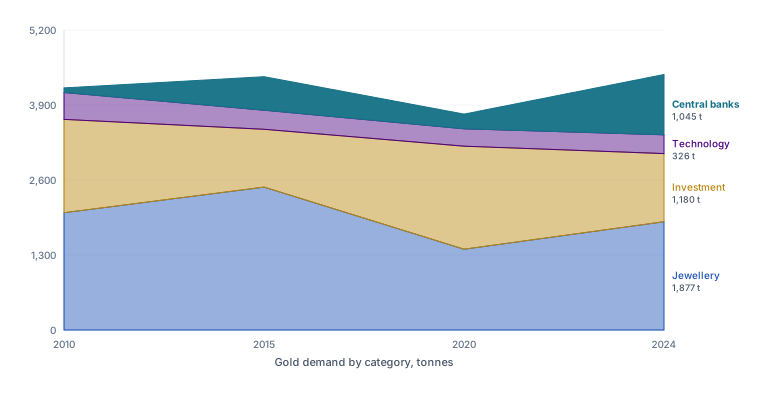
Figure data: Table 8.
2.3 Supply: producing countries
Annual gold supply has two sources — newly mined metal and recycled scrap (Section 2.5). Mine supply has crept up over the long run, from roughly 2,600 t in 2000 to ~3,300 t in 2025, but growth has flattened as new large discoveries have become rarer and grades have fallen — the “peak gold” debate. National output is led by China, Russia and Australia, with state-influenced production meaningful in China, Russia, Kazakhstan and Uzbekistan, and overwhelmingly private/listed production in Australia, Canada and the United States.
Table 9. World gold mine production, selected years (tonnes)
| Year | 2000 | 2005 | 2010 | 2015 | 2020 | 2023 | 2024 | 2025e |
|---|---|---|---|---|---|---|---|---|
| Mine production | 2,590 | 2,470 | 2,740 | 3,100 | 3,200 | 3,250 | 3,280 | 3,300 |
Source: USGS Mineral Commodity Summaries , gold chapters 2001–2026. Figures rounded.
Reserves — the economically mineable subset of resources — tell the longevity story, and here the ranking differs from current output: Australia and Russia hold the largest reserves (≈13,000 t and 12,000 t), followed by South Africa, Indonesia, China, Canada and the United States. Global reserves are ~66,000 t, roughly 20 years of mine supply at current rates — though resources (the broader geological endowment) are far larger.
Table 10. Top gold reserves by country, 2025 (tonnes)
| Country | Reserves (t) | Country | Reserves (t) |
|---|---|---|---|
| Australia | 13,000 | United States | 3,000 |
| Russia | 12,000 | Brazil | 2,500 |
| South Africa | 5,000 | Kazakhstan | 2,300 |
| Indonesia | 3,600 | Peru | 2,200 |
| China | 3,200 | Uzbekistan | 2,200 |
| Canada | 3,200 | World total | 66,000 |
Source: USGS Mineral Commodity Summaries 2026: Gold , February 2026.
2.4 The supply–demand balance
Gold’s balance works differently from a consumable commodity. Because almost nothing is destroyed, “demand” and “supply” must include flows into and out of the vast above-ground stock — central-bank buying, ETF flows and recycling all move metal between holders rather than consuming it. In broad terms, annual mine supply (~3,300 t) plus recycling (~1,370 t) ≈ total demand (~4,900–5,000 t), and the market clears through price and through the investment/official-sector “swing” rather than through a physical shortage. When investors and central banks want more gold than mines and scrap provide, the price rises until some holders sell — it rarely runs out. The forward view — demand drivers, the mine-supply plateau and central-bank buying — is detailed in Section 5.
At the country level, the meaningful split is between net-producing nations (Australia, Russia, which mine far more than they consume) and net-importing demand centres (India, the largest net importer, plus China, which both produces and consumes heavily). Switzerland appears as a giant gross importer and exporter because it is the world’s refining hub, not an end consumer.
Table 11. Illustrative gold net positions, 2024 (tonnes)
| Country | Mine output | Consumer demand | Net position |
|---|---|---|---|
| Australia | 284 | ~25 | +259 (net exporter) |
| Russia | 310 | ~75 | +235 (net exporter) |
| Canada | 200 | ~20 | +180 (net exporter) |
| China | 377 | ~815 | −438 (net importer) |
| India | ~13 | ~700 | −687 (net importer) |
Source: production from USGS , 2026; consumer demand from World Gold Council, Gold Demand by Country , 2024. Figures approximate; excludes investment and central-bank flows.
Figure 6. Gold net positions, major countries, 2024 (tonnes)
Figure data: Table 11.
2.5 Supply structure: mine, recycling & above-ground stock
Gold supply is overwhelmingly primary-mined but with a large, price-sensitive recycling layer that no consumable commodity has. In 2024, of ~4,975 t total supply, roughly 73% came from mines and ~27% from recycled scrap (old jewellery and electronics). Recycling is the elastic part of supply: when the price spikes, more old jewellery comes back to refiners — 2024 scrap hit ~1,370 t, the most since 2012 — which cushions price rises. A modest share of mined gold (~7–10%) is itself a by-product of copper and other base-metal mining, and that slice is largely inelastic to the gold price because the host mine’s economics are driven by copper.
The feature that truly sets gold apart is its stock-to-flow ratio. Because gold is hoarded rather than consumed, the ~216,000 t mined throughout history still exists, and annual new supply adds only ~1.5% to it. Above-ground stock divided by annual new supply is roughly 65 — far higher than any other commodity. That is precisely why gold supply is so price-inelastic and why gold behaves like money: no plausible surge in mining can flood the market.
Table 12. Gold supply mix, 2024
| Supply source | Volume (t) | Share of supply | Price elasticity |
|---|---|---|---|
| Mine production | ~3,661 | ~73% | Low (long lead times) |
| Recycled scrap | ~1,370 | ~27% | High (responds to price) |
| Total supply | ~4,975 | 100% | — |
| Memo: by-product gold | ~250–350 | ~7–10% of mine | Very low |
Source: World Gold Council, Gold Demand Trends Full Year 2024 ; by-product share from USGS , 2026. WGC mine figure uses Metals Focus methodology and is higher than the USGS estimate (~3,300 t). The two components sum slightly above the WGC total because ~55 t of net producer (de)hedging, not shown as a row, is netted off the total.
Figure 7. Gold supply mix — mine vs. recycled, 2024
Figure data: Table 12.
2.6 Trade flows: the London–Zurich–Asia axis
Gold’s trade map looks nothing like oil’s. Because it is worth roughly $110 million per tonne, gold travels by the aircraft-hold load, not the supertanker — so there are no maritime choke points (no Hormuz, no Malacca) to disrupt it. The vulnerability is concentration in two mid-chain hubs instead. London is the centre of price discovery and vaulting: the LBMA’s vaults (including the Bank of England) hold thousands of tonnes of “loco London” bullion that back the OTC market. Switzerland is the refining capital, processing well over half of the world’s newly mined and recycled gold — doré flows in from mines worldwide, and .9999 kilobars flow out to Asia.
The directional flow is consistent: mined doré moves from Africa, Latin America and Australia to refineries (heavily Swiss); refined bullion then moves east to the demand centres of China and India, with the United Arab Emirates (Dubai) a major regional entrepôt. China and India are the largest physical importers; Switzerland, the UK, Hong Kong and the UAE are the great transit hubs.
Table 13. Major gold trade hubs and roles
| Hub | Role | Direction |
|---|---|---|
| London (UK) | Price discovery, OTC clearing, vaulting | Storage / trading core |
| Switzerland | Refining (>50% of world) | Doré in → kilobars out |
| China | Largest consumer + producer | Net importer |
| India | Largest jewellery importer | Net importer |
| UAE (Dubai) | Regional trading entrepôt | Transit |
Source: LBMA , Swiss Federal Customs / Metals Focus and UN Comtrade , 2024.
Figure 8. Global gold trade flows
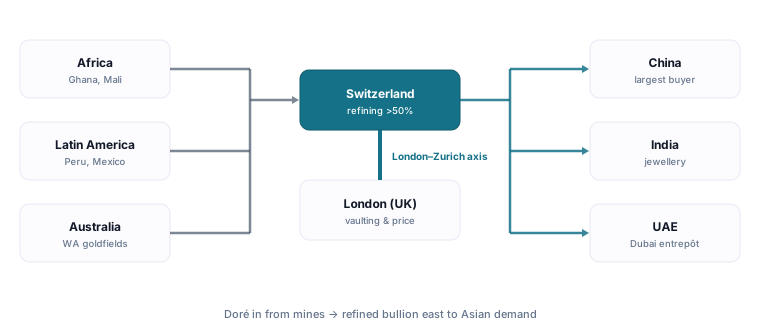
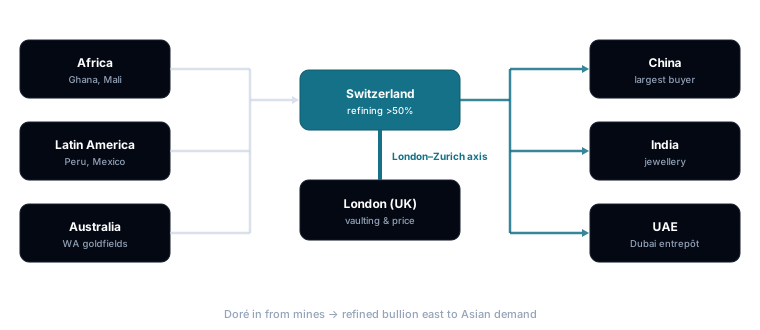
Source: LBMA, Swiss customs / Metals Focus and UN Comtrade, 2024; see Table 13.
2.7 Market organisations & the official sector
Gold has no OPEC — no producer cartel sets quotas or coordinates supply. The reasons are structural: production is spread across dozens of countries and hundreds of private companies, and the enormous above-ground stock means that even a coordinated mine cut could be offset by holders selling. Instead, two very different kinds of body shape the market.
First, the market organisers: the LBMA (London Bullion Market Association) sets the Good Delivery standards, accredits refiners and oversees the OTC market, while ICE Benchmark Administration runs the LBMA Gold Price auction and CME Group runs COMEX futures. These set the rules of trading, not the price level.
Second — and far more important for the price in the 2020s — the official sector. Central banks collectively hold roughly 36,000 tonnes of gold (about a fifth of all gold ever mined), and their holdings have moved through two distinct eras. Through the 1990s and 2000s the official sector was a net seller: European central banks sold under the 1999 Central Bank Gold Agreement and the IMF disposed of a tranche, pulling world official holdings down from roughly 33,000 t in 2000 to a trough near 30,200 t around 2009. The trend then reversed decisively. Led by emerging-market banks diversifying away from the dollar — the People’s Bank of China, Poland, Turkey, India, Kazakhstan and Russia among the most active — the official sector became a sustained net buyer, lifting holdings back above 36,000 t by 2024, with net purchases above 1,000 t in 2022, 2023 and 2024. This shift from seller to buyer is the single biggest change in the demand picture of the past decade, and it is why central-bank policy now sits alongside real interest rates as a primary price driver. The United States (~8,130 t), Germany, Italy, France and Russia hold the largest reserves.
Figure 9. Central-bank gold reserves, 2000–2024 (tonnes)
Source: World Gold Council and IMF International Financial Statistics, official-sector holdings, 2000–2024; figures approximate and rounded.
Table 14. Largest official gold holders
| Country | Reserves (t) |
|---|---|
| United States | 8,130 |
| Germany | 3,350 |
| Italy | 2,450 |
| France | 2,440 |
| Russia | 2,330 |
| China | 2,280 |
| Switzerland | 1,040 |
| India | 880 |
| Japan | 846 |
| Netherlands | 612 |
Source: World Gold Council, central-bank holdings , 2024–2025; IMF IFS. Latest reported reserves; figures approximate.
Table 15. Most active recent central-bank buyers
| Central bank | Net purchase (t) | Year |
|---|---|---|
| China (PBoC) | 225 | 2023 |
| Turkey (CBRT) | 148 | 2022 |
| Poland (NBP) | 130 | 2023 |
| Singapore (MAS) | 77 | 2023 |
| India (RBI) | 73 | 2024 |
| Egypt (CBE) | 47 | 2022 |
| Qatar (QCB) | 35 | 2022 |
| Iraq (CBI) | 34 | 2022 |
| Czech Republic (CNB) | 20 | 2024 |
| Kazakhstan (NBK) | 17 | 2024 |
Source: World Gold Council, Gold Demand Trends , 2022–2024. Net official purchases in the year shown; figures approximate and rounded.
Figure 10. Central-bank net gold purchases, 2010–2024 (tonnes)
Source: World Gold Council, Gold Demand Trends , 2010–2024.
3. The companies & the value chain
3.1 The largest gold companies
No single company controls more than ~2% of world output — gold mining is fragmented. The way to size up producers in an evergreen guide is by durable fundamentals — production, reserves and reserve life — not market capitalisation or share price, which move daily and date a report instantly. By annual output the leader is Newmont (US), enlarged by its 2023 acquisition of Newcrest, followed by Barrick (Canada), Agnico Eagle (Canada) and Russia’s Polyus, whose reserve base is among the world’s largest. Chinese giant Zijin Mining is a major gold producer that is also a top-tier copper miner.
Table 16. Leading gold producers by output and reserves, 2024
| Company | Country | Type | Listing | Production (Moz) | Gold reserves (Moz) | Reserve life (yrs) |
|---|---|---|---|---|---|---|
| Newmont | United States | Major (Au, Cu) | Public (NYSE: NEM) | 6.8 | 134 | ~20 |
| Barrick | Canada | Major (Au, Cu) | Public (NYSE: B; TSX: ABX) | 3.9 | 89 | ~23 |
| Agnico Eagle | Canada | Major (Au) | Public (NYSE/TSX: AEM) | 3.5 | 54 | ~15 |
| Polyus | Russia | Major (Au) | Public (MOEX: PLZL) | 2.9 | 104 | ~36 |
| AngloGold Ashanti | UK / South Africa | Major (Au) | Public (NYSE: AU) | 2.7 | 30 | ~11 |
| Zijin Mining | China | Diversified (Au, Cu) | Public (SSE: 601899; HKEX: 2899) | 2.3 | 75 | ~30 |
| Gold Fields | South Africa | Major (Au) | Public (NYSE/JSE: GFI) | 2.2 | 47 | ~21 |
| Kinross Gold | Canada | Major (Au) | Public (NYSE: KGC; TSX: K) | 2.1 | 24 | ~11 |
Source: company annual reports and reserve statements (10-K / AIF), full-year 2024; production and reserves as reported. Listing gives the primary exchange(s) and ticker: all eight trade publicly, though Polyus (MOEX) is effectively inaccessible to most Western investors under sanctions, and Zijin’s largest shareholder is state-linked. No market-capitalisation figures are shown by design.
3.2 Company archetypes along the value chain
Gold exposure is not one trade — the business models sit at very different points on the risk/return spectrum, and an investor should match the archetype to the goal (leverage, income, safety). Explorers look for deposits: pure option value, no cash flow, binary outcomes. Developers are permitting and building a mine: high capital risk, value unlocked at first pour. Producers mine and sell gold: direct, leveraged exposure to the gold price, with margins set by their position on the cost curve. Royalty & streaming companies finance miners in exchange for a slice of future output or revenue — they get gold-price upside with capped cost exposure and diversification, the lowest-risk way to own the theme. Physical bullion and ETFs track the metal itself with no operating risk at all.
Table 17. Gold company archetypes
| Archetype | What they do | Revenue model | Price sensitivity |
|---|---|---|---|
| Explorer | Search for deposits | None (raise & spend) | Very high (sentiment) |
| Developer | Permit & build mines | None until production | High |
| Producer | Mine & sell gold | Gold sales − cost | High (operating leverage) |
| Royalty / streaming | Finance miners for a cut | Royalty / stream income | Medium (capped cost) |
| Bullion / ETF | Hold physical gold | None (price only) | 1:1 with gold price |
Source: company filings; the Metal Pilot project-type taxonomy, 2025.
Figure 11. Gold company archetypes by price sensitivity
Source: company filings; conceptual, see Table 17.
3.3 Infrastructure & balance-sheet assets
What a gold company actually owns — and how those assets are measured — determines what its filings are telling you. A producer’s balance sheet is built on its mineral reserves and resources (measured in Moz, valued via the net present value of the mine plan at a discount rate), its mines and processing plants (open-pit or underground operations, mills, leach pads, measured by capacity and throughput), and its land/tenements (exploration upside). The number that most often misleads is gross vs. net: reserves and production are frequently quoted on a 100% basis even when the company owns only part of a joint venture, so the attributable (after partner and royalty) figure is the one that flows to shareholders.
Table 18. Gold-company asset types and metrics
| Asset type | What it does | Key metric | Unit |
|---|---|---|---|
| Reserves & resources | The in-ground ounce base | 2P reserves; resource grade | Moz; g/t |
| Mines (pit / underground) | Extract ore | Throughput; mine life | tonnes/yr; years |
| Processing / mill | Liberate gold from ore | Capacity; recovery | tonnes/yr; % |
| Royalty / stream interests | Claim on others’ output | Attributable ounces | Moz / yr |
| Tenements / exploration land | Future discovery upside | Area; drill results | km²; g/t |
Source: company reserve statements (SEC S-K 1300 / NI 43-101) and annual reports, 2024; Metal Pilot project data.
4. Investing in gold
4.1 Ways to own it — exposure vehicles
Before any screening framework comes the practical question: what do you actually buy? Gold offers more routes than any other commodity, and they differ far more in structure than in exposure. Physical bars and coins are the direct route: you pay a dealer premium over spot (highest on small coins), and you carry storage and insurance yourself. At larger size, vaulted metal splits into allocated (specific numbered bars held in your name — yours even if the custodian fails) and unallocated (a claim on a bank’s general gold pool — cheaper, but you are an unsecured creditor: counterparty risk in exchange for convenience). Bullion-backed ETFs hold allocated bars against shares and track spot tightly for an annual fee — the default vehicle for most investors. Futures offer direct, leveraged exposure with margin calls and roll mechanics, a professional’s tool. Miner equities and royalty/streaming companies are not gold — they are businesses geared to gold, covered in the archetype framework (Section 3.2) and the screening checklist below.
One structural caveat applies across commodities: a fund that holds futures rather than metal must roll its contracts as they expire, and in a contango market (futures above spot — gold’s normal state, reflecting the cost of carry) each roll sells cheap and buys dear, a recurring drag that compounds into a lasting gap versus the spot price. Gold is the lucky exception among major commodities — its main ETFs hold physical bullion, so the drag mostly doesn’t apply — but check the structure before assuming it: if the fund’s assets are futures, the caveat is yours. (The oil guide shows what this costs in practice.)
Table 19. Ways to own gold
| Vehicle | What you actually own | Tracks spot? | Key structural cost / risk | Best suited for |
|---|---|---|---|---|
| Bars & coins | Physical metal in hand | Yes, less premium | Dealer premium, storage, insurance | Long-term store of value |
| Allocated vault account | Specific numbered bars | Yes | Storage fee | Larger long-term holdings |
| Unallocated account | A bank’s promise to deliver | Yes | Counterparty risk (unsecured creditor) | Trading convenience |
| Bullion-backed ETF | Shares in a trust holding bars | Yes, tight | Annual fee; no possession | Most investors’ default |
| Futures | Exchange contract | Basis + roll | Leverage, margin calls, roll mechanics | Professionals, hedgers |
| Miner equities | A business geared to gold | No — amplifies | Operating & jurisdiction risk | Leverage to the price |
| Royalty / streaming | Financing claims on many mines | No — smoother | Deal risk, diversified | Lower-risk equity exposure |
Source: vehicle structures per LBMA custody definitions and exchange/issuer product documentation; structural attributes only — no fees or prices, which change.
4.2 How to value & screen gold miners
The facts above turn into a repeatable checklist. For a producer, the metrics that matter are the resource and reserve base (how many ounces, at what grade), all-in sustaining cost (AISC) per ounce (the headline cost figure — a low-cost miner near $1,100–1,300/oz keeps mining through a downturn; a high-cost miner above ~$1,800 is squeezed first), reserve life (how long it can produce before it must replace ounces), and the all-in margin (realised price minus AISC). For developers, it is the project’s NPV and internal rate of return at a conservative gold price, the capital cost, and the path to permits. For explorers, it is grade, drill results and management.
The single most useful tool is the cost curve: rank the world’s production from cheapest to most expensive AISC, draw the long-run average price across it, and you can see at a glance who earns a fat margin and who barely survives. The same data lets you compare a producer’s valuation against its reserves — the kind of screen (resource base, AISC, reserve life) you can run across every gold company on Metal Pilot .
Table 20. Gold-miner screening metrics
| Metric | What it tells you | Good vs. concerning | Where to find it |
|---|---|---|---|
| Reserves / resources (Moz) | Scale and longevity | Larger, higher-grade is better | Reserve statement |
| AISC ($/oz) | Cost competitiveness | <$1,400 healthy; >$1,800 stressed | Annual report / MD&A |
| Reserve life (yrs) | Runway before replacement | >10 comfortable; <7 a worry | Reserves ÷ production |
| All-in margin ($/oz) | Profit per ounce | Wider is better | Price − AISC |
| Grade (g/t) | Ore quality | Higher = lower cost | Reserve statement |
Source: company MD&A and reserve statements, 2024; cost-curve concept per the Metal Pilot model reference.
Figure 12. Illustrative gold cost curve (AISC vs. cumulative output)
Chart source: illustrative; AISC ranges from company MD&A, 2024, price line from Table 3. Stylised, not company-level data.
4.3 Macro regimes, rates & correlations
Gold’s behaviour across the economic cycle is the heart of the investment case, and it is best understood through one channel: gold pays no yield, so its appeal rises and falls with the opportunity cost of holding it — chiefly the real (inflation-adjusted) interest rate and the US dollar. (For how all the major commodities compare across these same regimes, see the macro regime guide .)
Gold tends to do best in: high or rising inflation when real rates are negative (the classic hedge); falling real rates and rate-cut cycles; crisis / risk-off episodes (a safe haven when equities and credit wobble); a weakening dollar (gold is dollar-priced, so a softer dollar lifts it); and stagflation, the regime it has historically loved most. It tends to struggle in: disinflation with strong growth and high real rates (the 2013–2015 bear), and a strongly rising dollar. The notable exception is 2022–2025, when gold rose despite high nominal rates — because central-bank buying and de-dollarisation overrode the rate signal, a reminder that the relationships are tendencies, not laws.
Table 21. Gold across economic regimes
| Regime | Typical gold performance | Why | Example |
|---|---|---|---|
| High / rising inflation | Strong (if real rates negative) | Store-of-value hedge | 1970s; 2020–2022 |
| Stagflation | Strongest | Hedge + safe haven, growth weak | 1973–1980 |
| Falling real rates / cuts | Strong | Lower opportunity cost | 2019–2020; 2024 |
| Recession / risk-off | Strong | Safe-haven flight | 2008; 2020 |
| Strong growth, high real rates | Weak | High opportunity cost | 2013–2015 |
| Disinflation, strong USD | Weak | Dollar headwind | 1996–1999 |
Source: long-run price series (LBMA ) with real-rate/CPI data from FRED , author analysis. Regime averages are historical, not predictive.
On past performance, gold delivered roughly +640% from its 2000 low to the 2011 peak, then fell ~45% into 2015, before a second bull doubled it again by 2024–2025. Over the full 2000–2025 window it has comfortably outpaced inflation, with equity-like long-run returns but a different risk profile — its drawdowns rarely coincide with equity drawdowns, which is the source of its diversification value. Past performance is not indicative of future results.
The equity amplifier. Miners are how many readers actually take the exposure, and operating leverage — fixed costs against a moving gold price — makes them a geared, noisier version of the metal, in both directions. In the 2000–2011 bull, while gold rose ~640%, the NYSE Arca Gold BUGS index (HUI) of unhedged miners rose roughly +1,500% from its late-2000 low; in the bear that followed, gold’s ~45% fall became a ~−84% collapse in the HUI from its 2011 peak to the January 2016 trough. The lesson holds for every regime row above: whatever gold does, the miners tend to do two to three times as hard — leverage to be sought or avoided deliberately, never a side effect. (Data: LBMA gold price and NYSE Arca HUI index history, 2000–2016 — concluded episodes.)
On correlations (monthly data, 2000–2024), gold has a negative relationship with US real rates (≈ −0.4 to −0.6, strong but weaker since 2022) and the dollar (≈ −0.3 to −0.5), a low and unstable relationship with CPI over short horizons (the inflation hedge works over years, not months), a near-zero correlation with the S&P 500 (the diversification property), and a strong positive correlation with silver (≈ +0.8). Traders track the pair through the gold/silver ratio — ounces of silver per ounce of gold — which has averaged roughly 60–70 this century and swung from ~30 at silver’s 2011 peak to ~125 in the 2020 panic; extremes flag which metal is historically cheap relative to the other. These correlations are sample-dependent and break down in crises, when most things briefly correlate.
Table 22. Gold correlations (monthly, 2000–2024)
| Asset | Correlation with gold | Note |
|---|---|---|
| US real rates (10y TIPS) | ≈ −0.5 (negative) | Core driver; weaker post-2022 |
| US dollar (DXY) | ≈ −0.4 (negative) | Dollar-priced asset |
| CPI / inflation | ≈ +0.1, unstable | Hedge over years, not months |
| S&P 500 | ≈ 0 (low) | The diversification property |
| Silver | ≈ +0.8 (high) | Moves together, silver more volatile |
Source: author analysis of FRED and LBMA series, monthly, 2000–2024. Correlations are time-varying and can break down in crises.
Figure 13. Gold correlations, monthly 2000–2024
Figure data: Table 22.
4.4 Price drivers & cycles
Stripping out the noise, the gold price is driven by a short list of forces — and the clearest evidence comes from concluded historical episodes, not live events. On the demand side: real interest rates (the dominant macro lever), the dollar, investment and ETF flows, central-bank buying, and crisis hedging. On the supply side: the slow, capital-intensive response of mine output (years from discovery to first pour) and the faster response of recycling. The recurring pattern is that gold leads at monetary turning points and lags real economic activity.
The settled case studies that illustrate the drivers: the 1971 end of the gold standard unleashed the 1970s bull, which peaked at $850 in January 1980 amid stagflation and geopolitical shock — followed by a 20-year bear as Paul Volcker’s high real rates restored confidence in the dollar. The 2001–2011 bull (the dot-com bust, 9/11, the global financial crisis, quantitative easing and negative real rates) carried gold from ~$280 to its 2011 peak. The 2013–2015 bear followed the “taper tantrum” and a strong dollar. The 2020 pandemic drove gold to a then-record ~$2,070 as real rates collapsed. Each of these is resolved history; the durable lesson is that gold rallies when confidence in real yields or in the financial system erodes, and falls when both are restored.
Figure 14. Six dates that made the modern gold market
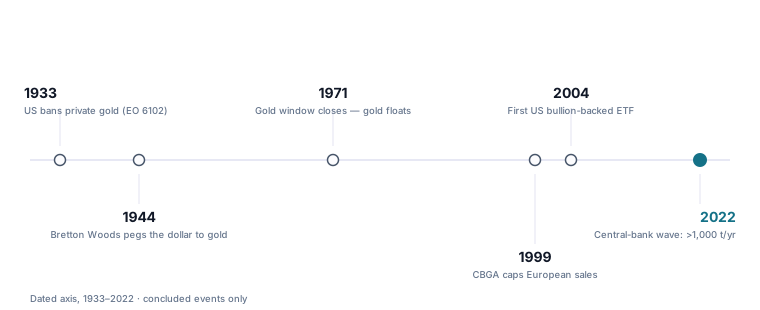
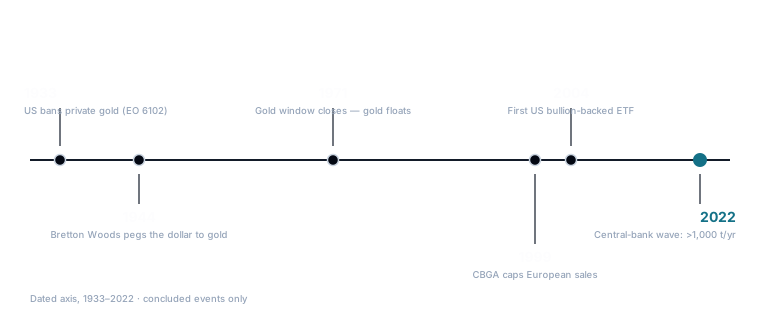
Source: LBMA price history and World Gold Council chronology; concluded events only, see Sections 2.7 and 4.4.
Table 23. Gold price drivers
| Driver | Direction of effect | Why | What to watch |
|---|---|---|---|
| Real interest rates | Lower rates → higher gold | Cuts opportunity cost | 10y TIPS yield |
| US dollar | Weaker USD → higher gold | Gold is dollar-priced | DXY index |
| Central-bank buying | More buying → higher gold | Structural demand | WGC quarterly data |
| Investment / ETF flows | Inflows → higher gold | Marginal price-setter | ETF holdings |
| Crisis / geopolitics | Risk-off → higher gold | Safe-haven bid | Volatility, conflict |
| Mine & scrap supply | More supply → mild drag | Slow, inelastic | USGS / WGC supply |
Source: agency outlooks (USGS , World Gold Council ) and long-run price history. Case studies are concluded historical episodes.
4.5 Risks, controversies & ESG
The bull case has real counterweights. The dominant financial risk is opportunity cost: gold pays nothing, so a sustained rise in real yields (a strong economy with positive real rates) is its natural enemy — and a stretch of that can mean years of dead money, as 2013–2018 showed. A strong dollar is a parallel headwind. A more specific 2020s risk is central-bank reversal: official-sector buying has become a major prop, and a slowdown or reversal would remove a key pillar of demand.
On the non-financial side, gold mining carries serious ESG exposure. Artisanal and small-scale gold mining (ASGM) is the single largest source of man-made mercury pollution, and the sector at large faces scrutiny over cyanide use, tailings-dam safety, water consumption, deforestation and Indigenous-community relations. Set against that, gold’s defenders note that recycling supplies a quarter of the market with a fraction of the footprint, and that a single high-value tonne of gold supports a far smaller physical disturbance than bulk commodities. There is little substitution risk — gold’s monetary role is unique — though thrifting reduces the gold content of electronics over time. These are contested questions, and reasonable analysts weigh them differently.
Figure 15. Gold risk map — likelihood vs. impact
Source: author’s qualitative assessment; see Section 4.5.
5. Future outlook & forecasts
Gold is unusual: it is not consumed but accumulated, so there is no multi-decade demand forecast of the kind agencies publish for oil or the industrial metals. Its forward view is a set of conditions and directions — central-bank accumulation, real interest rates, safe-haven demand — rather than a 2050 tonnage number.
5.1 Demand
The clearest forward signal is official-sector demand. In the World Gold Council (WGC) 2026 central-bank survey, 89% of reserve managers expect global central-bank gold holdings to keep rising over the next year, a record 45% plan to add to their own reserves, and 83% expect gold to be a larger share of reserves in five years — a structural shift as banks diversify away from the dollar. Central-bank buying has run near or above 1,000 t a year since 2022 (about a quarter of annual demand) and the WGC expects it to remain a primary support. Investment demand (bars, coins, ETFs) is counter-cyclical — it rises when real rates fall and uncertainty climbs — while jewellery (led by India and China) is price-sensitive and tends to soften as prices set records.
5.2 Supply: the “peak gold” question
Supply is famously inelastic. Annual mine output (~3,300 t) sits near a plateau — the “peak gold” thesis, as ore grades fall and large new discoveries thin out — and even sustained record prices lift it only slowly, because new mines take a decade-plus to permit and build. The flexible part is recycling (~1,370 t, roughly 27% of supply), which rises with the price and cushions rallies (Section 2.5). Because the vast above-ground stock (~210,000 t) dwarfs annual flows, gold never physically “runs short”: the market clears through price, not a supply gap — which is why gold, unlike an industrially consumed commodity, has no supply-vs-demand deficit to chart.
Table 24. Gold’s forward indicators (drivers, not a tonnage forecast)
| Driver | Recent level | Forward signal |
|---|---|---|
| Central-bank buying | >1,000 t/yr since 2022 (~¼ of demand) | 89% of reserve managers expect global holdings to rise; 45% plan to add (WGC 2026 survey) |
| Investment (bars, coins, ETFs) | counter-cyclical | rises as real rates fall and uncertainty climbs |
| Jewellery (India, China) | price-sensitive | softens at record prices |
| Mine supply | ~3,300 t/yr, near plateau | flat-to-down — the “peak gold” thesis |
| Recycling | ~1,370 t/yr | price-elastic; rises to cushion rallies |
Source: World Gold Council — Gold Demand Trends and the 2026 Central Bank Gold Reserves Survey , 2025–2026; USGS for mine supply. Forward-looking views are survey-based expectations, not measured data.
5.3 Catalysts to watch
The forward watch-list is concrete. In the near term, the path of Federal Reserve policy (rate cuts are supportive), the pace of central-bank buying (especially China and other emerging markets), ETF flows (which turned strongly positive in 2025), and geopolitical and de-dollarisation developments dominate. Over 3–10 years, the structural themes are continued reserve diversification away from the dollar, the “peak gold” question on the mine-supply side as grades fall and discoveries thin, and the demand pull from a growing Asian middle class. What would confirm the bull thesis: persistent official-sector buying and falling real rates. What would break it: a durable return to high positive real rates with a strong dollar and renewed confidence in financial assets.
Table 25. Gold catalyst calendar
| Catalyst / theme | Timing | Why it matters | Watch |
|---|---|---|---|
| Fed rate decisions | Ongoing (8×/yr) | Sets real-rate path | FOMC, dot plot |
| WGC Gold Demand Trends | Quarterly | Official-sector & demand data | gold.org |
| Central-bank reserve moves | Ongoing | Structural demand | IMF / WGC data |
| USGS Mineral Commodity Summaries | Annual (Jan/Feb) | Supply & reserves update | usgs.gov |
| ETF flows | Monthly | Marginal price-setter | WGC ETF data |
| Major mine start-ups / M&A | Multi-year | Supply pipeline | Company guidance |
Source: Federal Reserve , World Gold Council and USGS calendars.
6. Summary
Gold is the rare commodity that is also money. Physically it is a near-indestructible precious metal whose value rests on scarcity, durability and 2,500 years of monetary convention. Its price is set not by producers but in London and on COMEX, and quoted best as a multi-year average — which rose from ~$280/oz in 2000 to ~$2,386 in 2024 and an estimated ~$3,300 in 2025. It is mined everywhere — China, Russia and Australia lead, but no country tops ~12% — so there is no cartel and supply is highly inelastic, anchored by an above-ground stock-to-flow ratio near 65. Demand rests on jewellery (India and China), investment, technology and, decisively in the 2020s, central banks, which bought over 1,000 tonnes a year three years running. The market clears at roughly 3,300 t of mine supply plus ~1,370 t of recycling against ~4,900 t of demand, with London and Switzerland the physical choke points rather than any shipping lane. The companies that mine it — Newmont, Barrick, Agnico Eagle, Polyus and peers — are best compared on production, reserves and cost, never on a fast-moving market cap, and they span everything from binary explorers to low-risk royalty firms. Gold’s regime is clear: it rewards falling real rates, a weak dollar, inflation shocks and crises, and it struggles when real yields and the dollar both rise — with central-bank demand the wildcard that drove the 2022–2025 records. The single most important variable to watch is the real interest rate, with official-sector buying close behind.
To go from this big-picture view to the actual companies — screening every gold producer by reserves, AISC and reserve life — explore Metal Pilot .
7. Vocabulary
Every specialised term used in this report, defined once at first use in the body, collected here for reference.
Table 26. Gold vocabulary
| Term | Plain-language definition | Why it matters to an investor |
|---|---|---|
| Troy ounce (oz) | Precious-metal weight, 31.103 g; written “oz” here, sometimes “ozt” to set it apart from the everyday avoirdupois ounce | The unit every gold price is quoted in |
| Fineness / karat | Purity (parts per thousand / 24ths) | .9999 bullion vs. 18k jewellery; defines product |
| Doré | Impure gold-silver bars poured at the mine | The form supply leaves a mine in, before refining |
| Ore grade (g/t) | Grams of gold per tonne of rock | Decides whether a deposit is economic |
| Reserves vs. resources | Economically mineable (reserves) vs. broader geological estimate (resources) | Reserves are bankable; resources are upside, not proven |
| Proven & probable (2P) | The two reserve confidence categories | The reserve base used to value a producer |
| Cut-off grade | Lowest grade worth mining at a given price | Rises and falls with the gold price |
| Recovery rate | % of contained gold actually extracted | Drives real output and cost |
| AISC | All-in sustaining cost per ounce | The headline cost metric; who survives a downturn |
| C1 cash cost | Direct cash cost of production per ounce | Narrower cost measure, before sustaining capital |
| By-product credit | Revenue from co-products (e.g. copper) netted off cost | Can push a “gold” mine’s AISC down sharply |
| Reserve life | Reserves ÷ annual production (years) | How long a company can produce before it must replace ounces |
| Above-ground stock | All gold ever mined and still held (~216,000 t) | Gold’s defining feature; the basis of stock-to-flow |
| Stock-to-flow | Above-ground stock ÷ annual new supply | Why gold supply is so price-inelastic |
| Recycling / scrap | Gold recovered from old jewellery and electronics | The elastic, price-sensitive part of supply |
| Official sector | Central banks and similar institutions | The swing buyer of the 2020s |
| ETF (gold-backed) | Fund holding allocated bullion against shares | How investors get bullion exposure without storage |
| Loco London | Gold held/settled in London vaults | The deepest physical liquidity pool |
| Contango / backwardation | Futures above / below spot | Reflects cost of carry; signals market stress when inverted |
| Royalty / stream | A financing claim on a mine’s output or revenue | A lower-risk way to get gold-price exposure |
| Doré-to-bullion refining | Upgrading mine doré to .9999 bars | The concentrated mid-chain step (mostly Switzerland) |
| Hedging | Locking in a forward gold price | Reduces price upside as well as downside |
Source: definitions follow SEC S-K 1300 / CIM reserve standards and the World Gold Council glossary, 2025.
8. Sources, methodology & disclaimer
8.1 Sources, methodology & data vintage
Agencies & official data: USGS Mineral Commodity Summaries 2026: Gold ; USGS Gold Statistics and Information ; IMF International Financial Statistics ; FRED (Federal Reserve) for real rates and CPI.
Industry & exchanges: World Gold Council — Gold Demand Trends and data hub ; LBMA Gold Price ; CME Group / COMEX ; UN Comtrade for trade flows.
Company filings: annual reports, 10-K and AIF reserve statements (SEC S-K 1300 / NI 43-101) for Newmont, Barrick, Agnico Eagle, Polyus, AngloGold Ashanti, Zijin, Gold Fields and Kinross, full-year 2024.
Methodology: prices are calendar-year averages (LBMA 2000–2024; USGS Engelhard estimate for 2025), never spot snapshots. Production and reserves follow USGS for country data; demand and supply-mix follow the World Gold Council / Metals Focus framework, which estimates mine production higher (~3,661 t in 2024) than USGS (~3,280 t) owing to methodology — each figure is attributed to its source. Correlations use monthly data over 2000–2024 and are historical. Reserves, resources and forecasts are estimates, not measured facts.
Data as of: June 2026. Intended update cadence: annually, after the USGS Mineral Commodity Summaries (January/February) and the World Gold Council full-year Gold Demand Trends.
8.2 Disclaimer & disclosure
This report is for informational purposes only and is not investment advice, a recommendation, or an offer to buy or sell any security or commodity. Gold prices are volatile, and the figures here are estimates as of the stated date that will change; reserves, resources, correlations and regime averages are estimates and historical observations that may not persist. Do your own research and consult a licensed financial adviser before acting. This report was prepared with the assistance of AI; its figures were sourced from the references above and reviewed, but readers should verify any number before relying on it. The author holds no position disclosed as a conflict in respect of the companies named.