

Oil — A Complete Market Guide (2026)
Data as of 13 June 2026. Prices are quoted as multi-year and full-year averages, not a single day’s snapshot, so this report stays useful over time. Reserves, production splits, balances, and historical series are estimates from agency data, rounded for clarity. This report is for information only and was prepared with AI assistance — see the disclaimer at the end.
Oil is the single largest traded commodity on earth and still the backbone of the global energy system — and in the mid-2020s it is a market pulled in two directions at once, between OPEC+ quota discipline and record US shale output on the supply side, and between rising petrochemical demand and the electric-vehicle transition on the other. This report is the free, big-picture primer on how the oil market actually works: where crude comes from, who refines and burns it, how the price is set, and which economic regimes favour it. It covers crude and the liquids complex; natural gas, covered here only where inseparable, has its own guide . For the company-level data behind the story — every producer screened by reserves, breakeven and valuation — go to Metal Pilot .
TL;DR & Key Takeaways
The world consumes roughly 103 MMbbl/d (million barrels per day) of liquids, and crude plus refined products dominate seaborne trade. Over the last decade the price has cycled through extremes — from negative US prices in 2020 to over $120 in 2022 — which is exactly why this report anchors on averages rather than the latest tick: Brent averaged about $69/bbl in 2025 and roughly $81/bbl over 2021–2025.
- What it is: a fossil hydrocarbon that is both an energy source (≈57% of demand is transport) and a petrochemical feedstock (the fastest-growing demand segment). Quality runs on two axes — API gravity (light↔heavy) and sulfur (sweet↔sour) — and by extraction type (conventional vs. unconventional/shale).
- Who supplies it: the United States (≈13.6 MMbbl/d of crude), Russia (≈9.9), and Saudi Arabia (≈9.5) lead; just five countries pump about half the world’s crude.
- Who consumes it: the United States (≈19.0 MMbbl/d) and China (≈16.4) dominate, with India (≈5.6) the fastest-growing major market.
- Who controls the price at the margin: OPEC+ via quotas and Saudi spare capacity, plus the price-elastic response of US shale (new-well breakeven ≈ $65/bbl WTI).
- The regime that favors it: oil is pro-cyclical and a supply-shock/inflation hedge — strongest in expansion and during disruptions, weakest in recessions.
Numbers to remember: Brent ≈ $69/bbl (2025 avg); ≈ $81/bbl (2021–25 avg) · global demand ≈ 103 MMbbl/d · top producer USA ≈ 13.6 MMbbl/d · top consumer USA ≈ 19.0 MMbbl/d · ~20.9 MMbbl/d transits the Strait of Hormuz · largest reserves Venezuela ≈ 303 bn bbl · largest company Saudi Aramco ≈ 9.5 MMbbl/d.
Figure 1. Oil market at a glance — leaders & 5-year growth
Source: EIA, IEA, the Energy Institute, and company filings; production/demand are 2025 estimates and growth is the 2020–2025 average, as of 13 Jun 2026.
How to read this guide: new to oil? Read straight through from Section 1. Here for the investment case? Jump to Section 4 — vehicles, screening, regimes and risks. Every technical term is defined in the Vocabulary (Section 7).
1. Oil & the market basics
Before the market dynamics, the essentials: what oil physically is, how it is measured, and how it is priced. (Every specialised term is collected in the Vocabulary, Section 7.)
1.1 What oil is — physical basics & quality
Crude oil is a naturally occurring mixture of hydrocarbons formed from buried organic matter over geological time. Its economic importance is twofold. First, refined into gasoline, diesel, jet fuel, and fuel oil, it powers most of the world’s transport — a use that is hard to electrify at the heavy and long-haul end. Second, it is the feedstock for petrochemicals: the plastics, synthetic fibers, fertilizers, and solvents embedded in nearly every manufactured good. Natural gas, oil’s frequent geological companion, is both a fuel (power, heating, industry) and a feedstock, and is increasingly shipped globally as liquefied natural gas (LNG) — it appears throughout this guide where the two are produced and processed together, and gets full treatment in the natural gas guide .
Oil is not a uniform product, and quality drives price along three axes. API gravity measures density: “light” crude (high API) yields more high-value gasoline and diesel and commands a premium, while “heavy” crude (low API, e.g. Canadian or Venezuelan) is cheaper and needs more complex refining. Sulfur content splits crude into “sweet” (low sulfur, easier and cleaner to refine) and “sour” (high sulfur, discounted). And extraction type divides supply into conventional oil — crude that flows from a permeable reservoir under its own pressure or with simple pumping, the traditional model behind giant fields like Saudi Arabia’s Ghawar — and unconventional oil, which is trapped in rock that does not flow freely and must be coaxed out with technology such as hydraulic fracturing of shale, or mined and processed like Canadian oil sands. The US shale revolution is the unconventional story that reshaped the market over the past fifteen years.
The value chain runs from the wellhead through gathering systems and pipelines to refineries, which separate and convert crude into finished products, then through distribution to the end user. Natural gas follows a parallel path: wellhead → gathering → processing (to strip out natural gas liquids) → pipeline or LNG liquefaction → regasification → end use. The physical asset base includes drilling rigs and producing wells, gathering systems, long-haul pipelines and rail, refineries, LNG trains, storage, and marine export terminals served by tankers.
Figure 2. The oil & gas value chain
Source: standard oil & gas industry value-chain structure (upstream–midstream–downstream).
Inside the refinery — how crude becomes products. Crude oil is useless until it is split into specific fuels, and that transformation is the refinery’s job, in three broad stages. First, separation: after desalting (washing out salt and water), the crude is heated and fed to an atmospheric distillation column that splits it by boiling point — light gases and naphtha off the top, gasoline and kerosene/jet in the middle, diesel lower down, and a heavy residue that a vacuum distillation column divides further. Second, conversion, where low-value heavy fractions are chemically rebuilt into valuable light ones: catalytic cracking and hydrocracking break big molecules into gasoline and diesel, catalytic reforming raises naphtha’s octane, and coking wrings the last liquids from the bottom of the barrel. Third, treating and blending: hydrotreating strips out sulfur so fuels meet specification, and the streams are blended into finished gasoline, diesel, jet fuel and fuel oil. The margin a refiner captures across these steps is the crack spread (Section 3). In short: distillation separates, conversion upgrades, treating and blending finish the job — the petroleum analogue of a metal smelter-refinery.
1.2 Units & measurement conventions
This report follows the standard oil & gas convention in which M = thousand and MM = million (Roman numerals). So million barrels per day is written MMbbl/d, and thousand barrels per day is Mbbl/d. We avoid the ambiguous “mb/d.” Crude is measured in barrels (bbl), equal to 42 US gallons (~159 litres). Flows are quoted per day (bbl/d) and stocks (reserves, storage) in barrels.
Natural gas is measured by volume — cubic feet (cf), scaling to Mcf, MMcf, Bcf, and Tcf — or by energy content in MMBtu (million British thermal units). Because companies produce both, the industry uses barrels of oil equivalent (BOE), converting gas to oil on an energy basis at the convention 6,000 cubic feet of gas ≈ 1 BOE.
A key distinction throughout is flow versus stock: production is a flow (barrels per day), while reserves and inventories are stocks (barrels in place or in tank). A second nuance: “crude oil” production (≈83 MMbbl/d globally) is narrower than “total liquids” (≈103 MMbbl/d), which adds condensate, natural gas liquids, biofuels, and refinery processing gain. Where the two differ in this report, the basis is stated.
Table 1. Units & measurement conventions
| Unit | Meaning | Typical magnitude | Conversion |
|---|---|---|---|
| bbl | Barrel of crude | 1 barrel = 42 US gal | ≈ 159 litres |
| MMbbl/d | Million barrels/day | Country output (US ≈ 13.6) | 1 MMbbl/d ≈ 365 MMbbl/yr |
| Mbbl/d | Thousand barrels/day | Single-field output | 1,000 bbl/d |
| Mcf / Bcf | Thousand / billion cubic feet (gas) | US gas demand ≈ 100 Bcf/d | 6 Mcf ≈ 1 BOE |
| BOE | Barrel of oil equivalent | Oil + gas combined | 6,000 cf gas = 1 BOE |
| MMBtu | Million British thermal units | Henry Hub priced per MMBtu | ≈ 1 Mcf of gas |
Source: Standard industry/agency unit conventions, U.S. EIA ; BOE at 6,000 cf gas ≈ 1 BOE.
Intuition anchor: one very large crude carrier (VLCC) holds ≈ 2 MMbbl; global daily consumption (~103 MMbbl/d) would fill roughly 50 VLCCs every day.
1.3 Pricing & benchmarks
Crude trades against several regional benchmarks because oil’s quality and location both affect value. The two global references are Brent (light-sweet, North Sea, waterborne — the benchmark for roughly two-thirds of internationally traded crude, on ICE) and WTI (West Texas Intermediate, light-sweet, delivered at Cushing, Oklahoma — the US benchmark and most-traded futures contract, on CME/NYMEX). Dubai/Oman prices medium-sour Middle East crude flowing to Asia, and Western Canadian Select (WCS) prices heavy-sour Canadian crude at a steep discount to WTI. The persistent Brent–WTI spread reflects US logistics and export economics.
Prices are set both on exchanges and via price-reporting agencies (Platts, Argus) that assess physical cargo deals. The shape of the futures curve carries information: backwardation (near-term prices above later ones) signals a tight physical market, while contango signals oversupply.
Because a single day’s price is a snapshot that quickly goes stale, the meaningful way to describe the price regime is with averages. Brent averaged about $69/bbl in 2025 and roughly $81/bbl across 2021–2025; over the full decade 2016–2025 the average was about $68/bbl. The 2000–2025 annual averages below show both the violent short-term swings and the two great cycles the rest of this report keeps returning to — the 2003–2008 boom and crash, and the shale-era regime since 2014.
Table 2. Brent crude annual average price (USD/bbl), 2000–2025
| Year | 2000 | 2001 | 2002 | 2003 | 2004 | 2005 | 2006 | 2007 | 2008 | 2009 | 2010 | 2011 | 2012 |
|---|---|---|---|---|---|---|---|---|---|---|---|---|---|
| Brent avg | 28.5 | 24.4 | 25.0 | 28.8 | 38.3 | 54.5 | 65.1 | 72.4 | 96.9 | 61.7 | 79.5 | 111.3 | 111.7 |
| Year | 2013 | 2014 | 2015 | 2016 | 2017 | 2018 | 2019 | 2020 | 2021 | 2022 | 2023 | 2024 | 2025 |
|---|---|---|---|---|---|---|---|---|---|---|---|---|---|
| Brent avg | 108.7 | 99.0 | 52.4 | 43.7 | 54.2 | 71.3 | 64.2 | 42.0 | 70.9 | 100.9 | 82.5 | 80.5 | 69.1 |
Source: U.S. EIA — Europe Brent spot price FOB, annual and the Energy Institute Statistical Review of World Energy 2025 . Calendar-year averages, USD/bbl, rounded.
Natural gas is even more regional because it is expensive to move. The three references are Henry Hub (US, $/MMBtu), TTF (European benchmark), and JKM (Asian spot LNG). The wide gaps between them — Henry Hub has averaged in the low single digits per MMBtu while TTF and JKM have run several times higher — are what make LNG arbitrage and US export economics work; the natural gas guide covers that market in full.
Table 3. Crude & natural-gas pricing benchmarks
| Benchmark | What it prices | Pricing/delivery point | Typical position vs. Brent |
|---|---|---|---|
| Brent | Light-sweet, global | North Sea, waterborne (ICE) | The global reference |
| WTI | Light-sweet, US | Cushing, OK (CME) | Usually a few $/bbl below Brent |
| Dubai/Oman | Medium-sour, Asia-bound | Middle East | Discount to Brent (quality) |
| WCS | Heavy-sour, Canada | Hardisty, Alberta | Large discount to WTI |
| Henry Hub | US natural gas | Louisiana ($/MMBtu) | Separate market |
| TTF / JKM | European / Asian gas-LNG | NW Europe / NE Asia | Separate, often several × Henry Hub |
Source: U.S. EIA — Short-Term Energy Outlook and exchange specifications (ICE, CME). 2025.
2. Supply, demand & the market balance
This is the physical market: where oil sits in the ground, who consumes it, who produces it, how the two balance year to year, the unusual structure of supply, and how OPEC coordinates it.
2.1 Where oil is extracted — basins & fields
Oil sits where geology put it — in sedimentary basins where source rock, reservoir, and trap align. A handful of regions dominate. The Permian Basin (West Texas and New Mexico) is the engine of US shale and the single biggest growth story of the last fifteen years. Ghawar in Saudi Arabia is the largest conventional oil field ever discovered and still a pillar of global supply. Western Siberia anchors Russian output. Other heavyweights include the offshore Persian Gulf fields, Iraq’s southern fields around Basra, Canada’s Athabasca oil sands, Brazil’s offshore pre-salt, and the Guyana–Suriname offshore boom.
The geological lesson is concentration: a small number of super-basins and giant fields supply a disproportionate share of the world, which is why localized disruptions — a sanctioned country, a blockaded strait, a hurricane in the Gulf of Mexico — can move the global price.
Table 4. Major global oil basins & fields
| Basin / field | Country | Type | Crude (MMbbl/d, 2025) | Quality (°API; sweet/sour) | Breakeven (≈ $/bbl) | Reserves / resource (approx.) |
|---|---|---|---|---|---|---|
| Permian Basin | USA | Tight oil (shale) | ≈ 6.6 | ~38–45°, light sweet | $61–65 (new well) | Largest US resource; tens of bn bbl |
| Western Siberia | Russia | Conventional | ≈ 6.0 | ~30–32°, medium sour (Urals ~1.5% S) | ~$20–40 (full-cycle) | Bulk of Russia’s ~80 bn bbl |
| Persian Gulf offshore | Gulf states | Conventional offshore | ≈ 5.0 | ~27–33°, medium–heavy sour (Arab Heavy ~2.9% S) | ~$5–15 (low lifting cost) | Vast — Gulf holds ~half of world reserves |
| Pre-salt / Guyana | Brazil / Guyana | Deepwater conventional | ≈ 4.5 | ~29–32°, light–medium sweet (<0.6% S) | ~$25–40 (deepwater) | Brazil ~14 + Guyana >11 bn bbl |
| Ghawar | Saudi Arabia | Conventional (giant) | ≈ 3.8 | ~33°, medium sour (Arab Light ~1.9% S) | ~$5–10 (lowest in world) | ~48 bn bbl remaining |
| Athabasca oil sands | Canada | Oil sands (bitumen) | ≈ 3.5 | ~8–22°, heavy sour (WCS 20.6°, 3.5% S) | ~$40–45 (SAGD sustaining) | ≈ 160 bn bbl reserves |
Source: U.S. EIA — Short-Term Energy Outlook and IEA Oil 2025 ; crude quality from ExxonMobil crude assays ; reserves from OPEC and company filings. 2025; crude + condensate, MMbbl/d. API/sulfur are typical blend values; reserves/resource are recoverable estimates; breakevens are new-well (shale) or approximate lifting / full-cycle (conventional, offshore, oil sands) figures and are not directly comparable across types.
North American basins in focus
North America is the center of gravity for non-OPEC supply, and almost all of its growth has come from unconventional rock. The United States alone pumps ≈13.6 MMbbl/d of crude, Canada ≈4.9, and Mexico ≈1.6 — together close to a fifth of world output. The defining contrast is quality. US tight-oil plays — the Permian above all, plus the Bakken, Eagle Ford, DJ/Niobrara, and Anadarko (SCOOP/STACK) — yield light, sweet crude (high API, low sulfur) that refines cleanly and trades near WTI, but they decline fast and must be drilled continuously, so their economics hinge on a new-well breakeven of roughly $60–65/bbl WTI. Canada’s oil sands are the mirror image: a vast, long-life resource (~160 bn bbl of reserves) of heavy, sour bitumen — Western Canadian Select averages ≈20.6° API and 3.5% sulfur — that sells at a deep discount and needs complex refining, yet has very low decline and sustaining costs once built. Offshore, the US Gulf of Mexico (≈1.9 MMbbl/d) and Mexico’s Bay of Campeche add medium-to-heavy conventional crude with high upfront cost but long plateau life.
Table 5. Major North American oil basins & plays
| Basin / play | Region | Type | Crude (MMbbl/d, 2025) | Quality (°API; sweet/sour) | Breakeven (≈ $/bbl) | Reserves / resource (approx.) |
|---|---|---|---|---|---|---|
| Eagle Ford | South Texas | Tight oil + condensate | ≈ 1.2 | ~40–55°, light sweet | ~$62 (new well) | ~10 bn bbl recoverable |
| Bakken (Williston) | North Dakota / Montana | Tight oil (shale) | ≈ 1.2 | ~40–43°, light sweet | ~$64 (new well) | ~7 bn bbl recoverable |
| DJ / Niobrara | Colorado / Wyoming | Tight oil (shale) | ≈ 0.5 | ~40–50°, light sweet | ~$60–65 (new well) | A few bn bbl |
| Anadarko (SCOOP/STACK) | Oklahoma | Tight oil + condensate | ≈ 0.5 | ~40–55°, light sweet | ~$62–65 (new well) | A few bn bbl |
| Gulf of Mexico (federal offshore) | Offshore TX / LA | Conventional deepwater | ≈ 1.9 | ~29–35°, medium, mixed (sweet & sour) | ~$35 (sustaining) | ~5 bn bbl proved |
| Alaska North Slope | Alaska (Prudhoe Bay area) | Conventional | ≈ 0.4 | ~31–32°, medium, slightly sour | legacy / low operating cost | ~2–3 bn bbl proved (+ frontier) |
| W. Canada conventional & tight (Montney, Cardium, Clearwater) | Alberta / BC / Saskatchewan | Tight & conventional | ≈ 1.4 | light oil & condensate, sweet | ~$45–55 | Billions of bbl |
| SE Mexico offshore (Campeche — Ku-Maloob-Zaap) | Bay of Campeche | Conventional offshore | ≈ 0.8 (Maya) | ~21–22°, heavy sour (Maya 3.4% S) | legacy (declining) | ~6 bn bbl proved (falling) |
Source: EIA — U.S. crude oil production rose in 2025, setting a new record , Dallas Fed Energy Survey (new-well breakevens), CAPP — The Oil Sands and Oil Sands Magazine — Western Canadian Select , and Pemex — Maya crude . 2025; crude + condensate, MMbbl/d. The two North American anchors — the Permian and the Athabasca oil sands — are profiled in Table 4 above; this table adds the remaining plays. API/sulfur are typical blend values; reserves/resource are recoverable estimates; breakevens are new-well (shale) or project/sustaining (offshore, oil sands) approximations and are not directly comparable across types.
2.2 Demand & consumption
The world consumes roughly 103 MMbbl/d of liquids. Demand is led by the United States (≈19.0 MMbbl/d, ~19% of the world) and China (≈16.4 MMbbl/d, ~16%), with India (≈5.6 MMbbl/d) the fastest-growing major consumer; Saudi Arabia (≈3.8) and Russia (≈3.7) round out the top five, followed closely by Japan (~3.3). The top ten consumers account for about 61% of global demand.
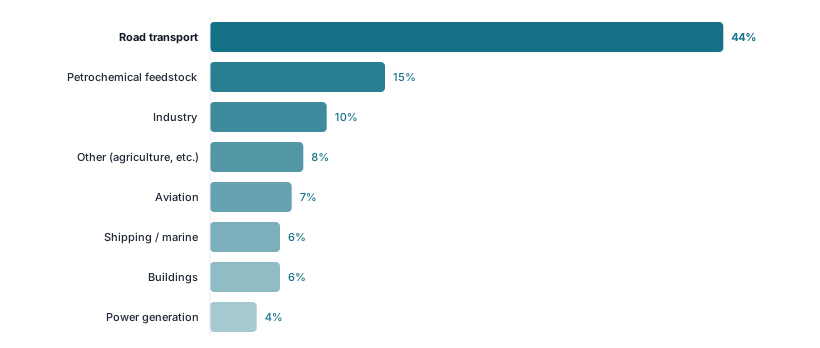
By end use, transport is dominant at more than 57% of demand, split across road, aviation, and shipping. The structural shift now underway is twofold: road-fuel demand in developed markets is flattening as electric vehicles and efficiency bite, while petrochemical feedstock is becoming the main engine of demand growth — the IEA expects petrochemicals to be the dominant source of oil-demand growth from 2026 onward — more than a third of the growth to 2030 — with polymers and synthetic fibers alone requiring ~18.4 MMbbl/d (about one barrel in six) by 2030. Net of these forces, the IEA projects total demand to plateau around 2030.
Table 6. Top oil consumers, 2025
| Top consumer (2025) | Consumption (MMbbl/d) | Share |
|---|---|---|
| United States | ≈ 19.0 | ~19% |
| China | ≈ 16.4 | ~16% |
| India | ≈ 5.6 | ~5.5% |
| Saudi Arabia | ≈ 3.8 | ~3.7% |
| Russia | ≈ 3.7 | ~3.6% |
Source: Energy Institute Statistical Review of World Energy 2025 and the U.S. EIA Short-Term Energy Outlook . 2025, MMbbl/d, total liquids.
Table 7. Oil demand by end use, 2025
| End use | What it covers (examples) | Share of demand (approx.) | Trend |
|---|---|---|---|
| Road transport | Cars, trucks and buses — gasoline & diesel | ~44% | Flattening in developed markets (EVs, efficiency) |
| Petrochemical feedstock | Plastics, fertilizers, synthetic fibers — naphtha & ethane | ~15% | Main driver of future growth |
| Industry | Process heat, machinery, construction, mining | ~10% | Slowly declining share |
| Other (agriculture, etc.) | Farm & off-road equipment, lubricants, bitumen, solvents | ~8% | Broadly stable |
| Aviation | Jet fuel for passenger & cargo flights | ~7% | Recovering and growing |
| Buildings (residential, commercial) | Heating oil and LPG for heating & cooking | ~6% | Declining with electrification |
| Shipping / marine | Bunker fuel for cargo ships & tankers | ~6% | Slow growth |
| Power generation | Oil-fired electricity — peaking, islands, backup | ~4% | Declining (gas / renewables substitution) |
Source: IEA Oil 2025 . Shares of total liquids demand, approximate. Transport (road + aviation + shipping) ≈ 57%.
The annual history below shows global demand (total liquids) for 2015–2025 — the only sharp decline is the 2020 pandemic, after which demand recovered to new highs.
Table 8. Global oil demand (MMbbl/d), 2015–2025
| Year | 2015 | 2016 | 2017 | 2018 | 2019 | 2020 | 2021 | 2022 | 2023 | 2024 | 2025 |
|---|---|---|---|---|---|---|---|---|---|---|---|
| Demand (MMbbl/d) | 95 | 96.5 | 98 | 99.3 | 100.5 | 91 | 97 | 99.8 | 102 | 103 | 103.5 |
| YoY change | — | +1.6% | +1.6% | +1.3% | +1.2% | −9.5% | +6.6% | +2.9% | +2.2% | +1.0% | +0.5% |
Source: Energy Institute Statistical Review of World Energy 2025 and IEA Oil Market Report (Dec 2025) . Total liquids, MMbbl/d (approx.).
Oil consumption is now led by Asia Pacific, which overtook North America during the 2010s, while Europe’s share has steadily declined. The regional split below — 2000, 2015 and 2025 — feeds the chart that follows, which interpolates the full 2000–2025 path.
Table 9. Oil demand by region, 2000–2025 (selected years)
| Region | 2000 (MMbbl/d) | 2015 (MMbbl/d) | 2025 (MMbbl/d) | Share 2025 |
|---|---|---|---|---|
| Asia Pacific | ≈ 21.1 | ≈ 33.4 | ≈ 40.7 | ~39% |
| North America | ≈ 23.8 | ≈ 24.1 | ≈ 24.4 | ~24% |
| Europe | ≈ 15.7 | ≈ 14.4 | ≈ 12.9 | ~12% |
| Middle East | ≈ 4.8 | ≈ 8.0 | ≈ 9.0 | ~9% |
| S. & C. America | ≈ 4.9 | ≈ 6.5 | ≈ 6.5 | ~6% |
| CIS / Eurasia | ≈ 3.6 | ≈ 4.5 | ≈ 5.0 | ~5% |
| Africa | ≈ 2.5 | ≈ 4.2 | ≈ 5.0 | ~5% |
Source: author’s regional estimates based on the Energy Institute Statistical Review of World Energy 2025 . Total liquids, MMbbl/d, approximate; the 2000 column extends the series because the chart below covers 2000–2025.
Figure 3. Global oil demand by region, 2000–2025
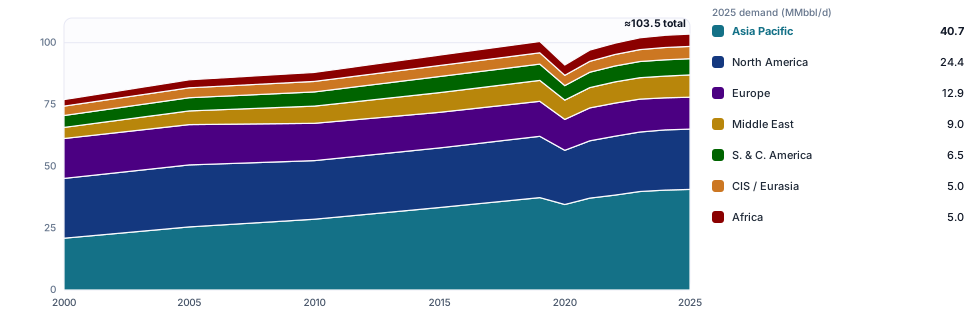
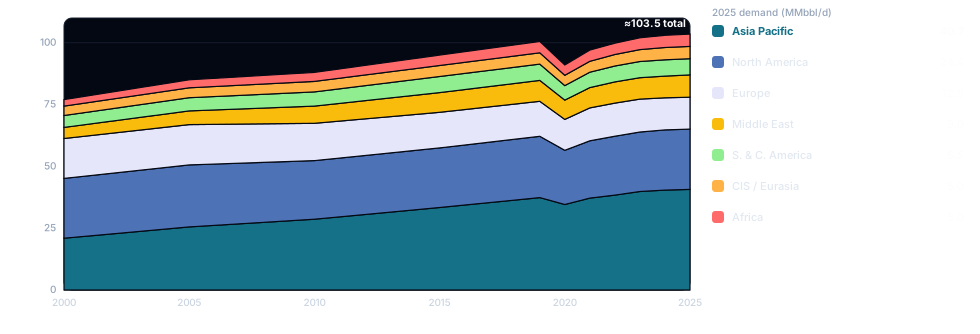
Source: author’s regional estimates from the Energy Institute Statistical Review of World Energy 2025 ; total liquids, approximate (data in Table 9).
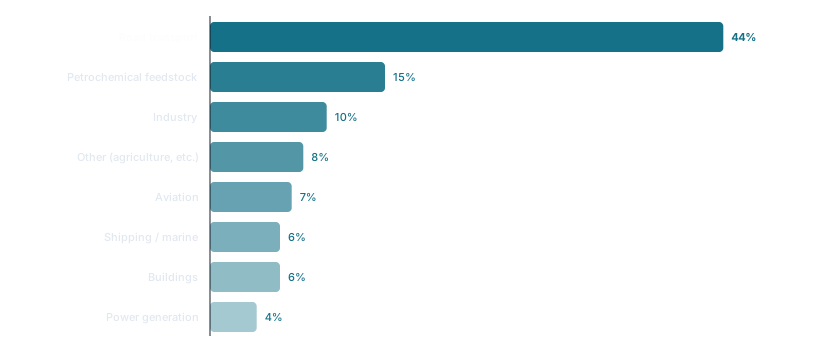
Figure 4. Oil demand by end use, 2025
Source: IEA Oil 2025 ; shares of total liquids demand, approximate (data in Table 7).
2.3 Supply: producing countries
Global crude supply is concentrated. The United States led 2025 production at ≈13.6 MMbbl/d (crude plus lease condensate), ahead of Russia (≈9.9) and Saudi Arabia (≈9.5); Canada (≈4.9), Iraq (≈4.4), China (≈4.3), and Iran (≈4.2) round out the top tier. The top five countries produce about half the world’s crude, and the Middle East as a region supplies roughly a third.
A defining feature is the split between state-controlled and private production. National oil companies (NOCs) — Saudi Aramco, Russia’s producers, the National Iranian Oil Company, ADNOC, Iraq’s state firms — control the majority of the world’s reserves and a large share of low-cost output, giving governments direct leverage over supply. The US is the great exception: its output comes from hundreds of private companies responding to price signals, which makes American shale the world’s most price-elastic source of supply.
Table 10. Top oil-producing countries, 2025
| Country | Crude production (2025) | Global share | Trend |
|---|---|---|---|
| United States | ≈ 13.6 MMbbl/d | ~13% | Growth slowing but elevated |
| Russia | ≈ 9.9 MMbbl/d | ~10% | Constrained by sanctions/OPEC+ |
| Saudi Arabia | ≈ 9.5 MMbbl/d | ~9% | Holds spare capacity in reserve |
| Canada | ≈ 4.9 MMbbl/d | ~5% | Rising (oil sands, pipelines) |
| Iraq | ≈ 4.4 MMbbl/d | ~4% | Growing |
| Iran | ≈ 4.2 MMbbl/d | ~4% | Volatile (sanctions/conflict) |
Source: U.S. EIA — Short-Term Energy Outlook and EIA international production data . Jan–Nov 2025 annualized, crude + condensate, MMbbl/d.
On reserves, Venezuela (~303 bn bbl), Saudi Arabia (~267), Iran (~209), and Canada (~163) hold over half the world’s proven crude (year-end 2024), though Venezuela’s and Canada’s figures depend heavily on counting heavy oil and oil sands.
Figure 5. Top oil-producing countries, 2025
Source: U.S. EIA — Short-Term Energy Outlook ; crude + condensate (data in Table 10).
2.4 The supply–demand balance
Putting production and consumption side by side reveals where the market is tight or loose and which countries are structurally long or short of oil. On a total-liquids basis (production here includes crude, condensate, NGLs, and refinery gain), global supply and demand track each other closely year to year, with the gap absorbed by inventories. The notable imbalances are the 2015–16 glut (surging US shale met OPEC’s decision not to cut), the 2020 surplus (demand collapsed faster than supply could be cut, flooding storage), the 2021–2022 deficit (recovery outran supply, drawing inventories down), and the renewed surplus building in 2025 as OPEC+ unwound its cuts. The multi-year demand and supply outlook is detailed in Section 5.
Table 11. Global oil supply–demand balance
| Year | Supply (MMbbl/d) | Demand (MMbbl/d) | Balance |
|---|---|---|---|
| 2000 | 77 | 77 | ≈ 0 |
| 2005 | 85 | 85 | ≈ 0 |
| 2010 | 88 | 88 | ≈ 0 |
| 2015 | 96 | 95 | +1 (glut) |
| 2016 | 97 | 96.5 | +0.5 (surplus) |
| 2017 | 97.7 | 98 | −0.3 (deficit) |
| 2018 | 99.6 | 99.3 | +0.3 (≈ 0) |
| 2019 | 100.5 | 100.5 | ≈ 0 |
| 2020 | 94 | 91 | +3 (surplus) |
| 2021 | 95.5 | 97 | −1.5 (deficit) |
| 2022 | 100 | 99.8 | ≈ 0 |
| 2023 | 102 | 102 | ≈ 0 |
| 2024 | 102.8 | 103 | ≈ 0 |
| 2025 | 104.5 | 103.5 | +1 (surplus) |
Source: IEA Oil Market Report (Dec 2025) and the U.S. EIA . Total liquids, MMbbl/d (approx.).
At the country level, the balance between what a nation produces and what it consumes determines whether it is a net exporter or a net importer — and therefore the global trade flows. The table below is on a total-liquids basis; note that the United States is a net exporter of total petroleum (since ~2020) even though it remains a net crude importer, because it exports large volumes of products and NGLs. So the US figure here — ≈21.9 MMbbl/d of total liquids — is its crude output (≈13.6, Table 10) plus NGLs, refinery processing gain, and biofuels, which is why it looks bigger than the crude number in the producer table.
Table 12. National net oil positions
| Country | Production — total liquids (≈) | Consumption (≈) | Net position |
|---|---|---|---|
| United States | ≈ 21.9 | ≈ 19.0 | Net exporter (+2.9) |
| Saudi Arabia | ≈ 11.1 | ≈ 3.8 | Net exporter (+7.3) |
| Russia | ≈ 10.5 | ≈ 3.7 | Net exporter (+6.8) |
| Canada | ≈ 5.8 | ≈ 2.4 | Net exporter (+3.4) |
| China | ≈ 4.6 | ≈ 16.4 | Net importer (−11.8) |
| India | ≈ 0.8 | ≈ 5.6 | Net importer (−4.8) |
| Japan | ≈ 0.1 | ≈ 3.3 | Net importer (−3.2) |
Source: Energy Institute Statistical Review of World Energy 2025 and the U.S. EIA . Figures approximate, total-liquids basis (MMbbl/d), 2024–25.
Figure 6. National net oil positions
Source: Energy Institute Statistical Review 2025 and the U.S. EIA ; total-liquids basis, approximate (data in Table 12).
2.5 Supply structure & co-products
Oil’s supply structure differs fundamentally from a metal’s, and the by-product/recycling lens still applies — just with different answers.
Primary vs. co-product. Crude oil is almost entirely primary-extracted: it is the target of the well, not a by-product of something else. The important co-product relationships run the other way. Oil wells often produce associated natural gas, and gas wells produce natural gas liquids (NGLs) — ethane, propane, butane — and condensate, a very light liquid. The liquids cut of a well (how much oil and NGL versus dry gas it yields) is decisive for shale economics, because liquids are worth far more per BOE than gas. In gas basins, oil and NGLs can be the valuable co-products that make a “gas” well profitable; in oil basins, associated gas is sometimes a near-worthless by-product that is flared or re-injected. This is the oil-patch analogue of a metal’s by-product credit.
Recycling / secondary supply. Unlike metals, oil is consumed, not recycled — once burned as fuel, a barrel is gone, so there is essentially no secondary supply. The only minor analogues are re-refined used lubricating oil (a small, niche stream) and the reuse of refinery by-products. There is no scrap market propping up supply, which is precisely why depletion and decline rates dominate the long-run picture and why the market is so sensitive to disruptions.
Stock vs. flow. Because there are no above-ground “reserves” in the metals sense, the relevant inventory is commercial and strategic storage plus OECD stock levels, which the market watches obsessively as a real-time gauge of balance. Strategic petroleum reserves (held notably by the US, China, and Japan) are the closest thing to an above-ground buffer.
Table 13. Oil supply sources & behavior
| Supply source | Role | Behavior |
|---|---|---|
| Primary crude extraction | ~all of supply | Subject to depletion; needs constant drilling |
| Associated gas / NGLs / condensate | Co-products of oil & gas wells | Shape well economics; act like by-product credits |
| Recycled / re-refined oil | Negligible | Not a real source of supply |
| Strategic & commercial storage | Buffer (stock, not new supply) | Smooths short-term shocks |
Source: U.S. EIA and IEA Oil 2025 . Qualitative supply-structure summary.
Key implication: with essentially no recycling and high natural decline rates, oil supply must be continuously replaced, making the market structurally vulnerable to disruption — the opposite of a high-recycling metal like copper or gold.
2.6 Trade flows & chokepoints
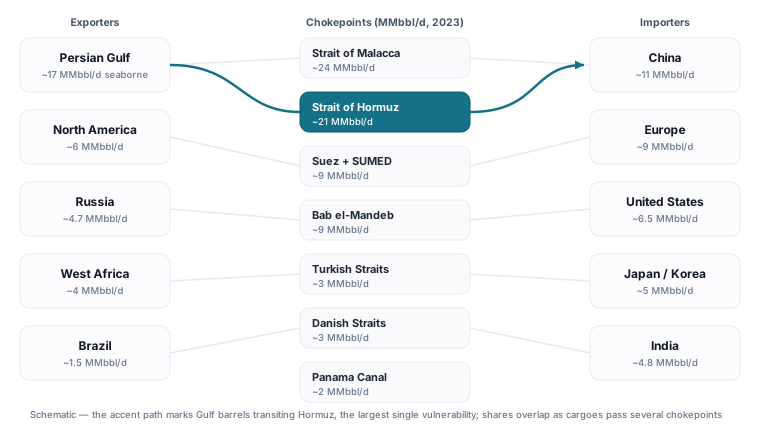
The net positions above become physical flows: roughly two-fifths of the world’s oil crosses an ocean on its way from wellhead to refinery, making crude and products the largest cargo in seaborne trade. The great exporting hubs are the Persian Gulf (Saudi Arabia, Iraq, the UAE and Kuwait, shipping mainly east to Asia), Russia (rerouted from Europe to India and China since 2022), North America (US light crude to Europe and Asia, Canadian heavy south to US refiners by pipeline), and West Africa and Brazil. The great importing centres are China and India — which together absorb most of the Gulf’s and Russia’s seaborne barrels — plus Europe, Japan and South Korea. The United States sits uniquely on both lists: its refiners import heavy sour crude that shale doesn’t produce while exporting the light sweet barrels it has in surplus — a quality mismatch, not a contradiction.
Table 14. Top crude exporters, 2024 (approximate)
| Rank | Exporter | Crude exports (MMbbl/d) | Main destinations |
|---|---|---|---|
| 1 | Saudi Arabia | ≈ 6.5 | Asia (China, India, Japan, Korea) |
| 2 | Russia | ≈ 4.7 | India, China (rerouted since 2022) |
| 3 | Canada | ≈ 4.1 | United States (pipeline + TMX) |
| 4 | United States | ≈ 4.1 | Europe, Asia (light sweet) |
| 5 | Iraq | ≈ 3.4 | Asia, Europe |
| 6 | UAE | ≈ 2.9 | Asia |
Source: U.S. EIA international trade data and the Energy Institute Statistical Review of World Energy 2025 . Crude + condensate, 2024, approximate and rounded.
Table 15. Top crude importers, 2024 (approximate)
| Rank | Importer | Crude imports (MMbbl/d) | Note |
|---|---|---|---|
| 1 | China | ≈ 11.0 | Largest importer by far; Gulf + Russia supplied |
| 2 | United States | ≈ 6.5 | Imports heavy sour despite exporting light sweet |
| 3 | India | ≈ 4.8 | Fastest-growing importer; big Russian share |
| 4 | South Korea | ≈ 2.7 | Gulf-dominated slate |
| 5 | Japan | ≈ 2.4 | Gulf-dominated slate, declining |
| 6 | Germany | ≈ 1.7 | Seaborne + Druzhba replacement |
Source: U.S. EIA international trade data and the Energy Institute Statistical Review of World Energy 2025 . Crude + condensate, 2024, approximate and rounded; the US appears in both tables because it exports light sweet shale crude while importing the heavy sour grades its refineries are built for.
Because so much of that trade funnels through a handful of narrow waterways, maritime chokepoints are oil’s defining vulnerability — the reason a regional incident can move the global price within minutes. The Strait of Hormuz is the one that matters most: about 20.9 MMbbl/d of crude, condensate and products — roughly a fifth of global consumption — passed through it in 2023, and Saudi and UAE bypass pipelines can reroute only a fraction. The Strait of Malacca carries even more (~23.7 MMbbl/d) on the way to China, Japan and Korea, but has practical (if longer) alternatives through Indonesian straits. The Red Sea pair — Suez/SUMED and Bab el-Mandeb — showed the system under stress when attacks on shipping from late 2023 pushed much of that traffic onto the longer Cape of Good Hope route: costly and slower, but survivable, which is why the market treats Red Sea risk differently from Hormuz risk.
Table 16. World oil transit chokepoints (2023 baseline)
| Chokepoint | Flow (MMbbl/d, 2023) | Share of seaborne oil | Workaround |
|---|---|---|---|
| Strait of Malacca | ≈ 23.7 | ~30% | Sunda/Lombok straits (longer) |
| Strait of Hormuz | ≈ 20.9 | ~27% | Limited Saudi/UAE bypass pipelines |
| Suez Canal + SUMED pipeline | ≈ 9.2 | ~12% | Cape of Good Hope (+10–15 days) |
| Bab el-Mandeb | ≈ 8.8 | ~11% | Cape of Good Hope |
| Turkish Straits | ≈ 3.4 | ~4% | Limited pipeline alternatives |
| Danish Straits | ≈ 3.2 | ~4% | Baltic pipelines (limited) |
| Panama Canal | ≈ 2.1 | ~3% | Cape Horn / US land bridge |
Source: U.S. EIA — World Oil Transit Chokepoints , 2023 volumes (the latest pre-disruption baseline); Red Sea flows (Suez, Bab el-Mandeb) have run well below these levels since the 2024 rerouting to the Cape. Crude + condensate + products. Shares overlap and do not sum to 100% — a single cargo can transit more than one chokepoint (e.g. Hormuz then Malacca).
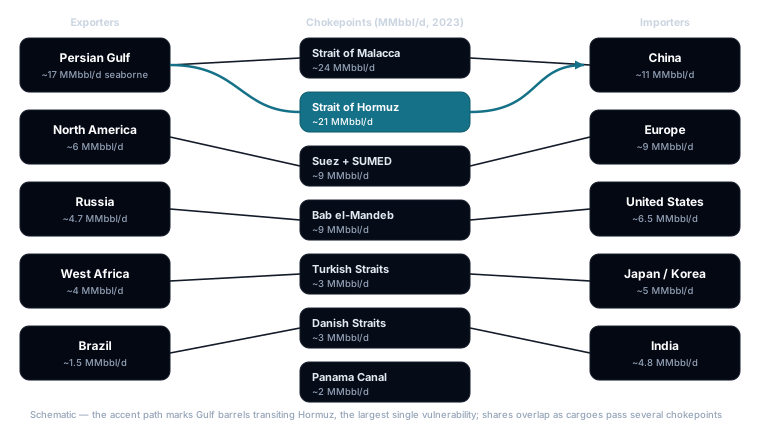
Figure 7. Global oil trade flows and chokepoints
Source: U.S. EIA World Oil Transit Chokepoints and trade data; see Tables 14–16.
The economics behind the map: the VLCC (Section 1.2) is the workhorse of long-haul trade, and freight is a small share of the delivered price in normal times — so crude flows to whichever refinery pays best globally, with traders (Vitol, Trafigura, Glencore) and national stockpiles (Section 2.8) at the centre of the physical market. Chokepoint risk is priced as an episodic premium, not a constant (Section 5).
2.7 OPEC & supply coordination
Oil is the one major commodity with an explicit supply cartel. OPEC (the Organization of the Petroleum Exporting Countries), founded in 1960, coordinates production among its members to manage prices. As of mid-2026 OPEC has eleven members (each with its crude output in the table below) after a run of departures: Qatar left in 2019, Angola at the start of 2024, and the United Arab Emirates withdrew from both OPEC and OPEC+ effective May 2026.
The broader OPEC+ alliance adds major non-OPEC producers — most importantly Russia, alongside Kazakhstan, Mexico, Oman, Azerbaijan and others (all in the table below) — to coordinate output across a much larger share of world supply. The group’s real leverage is spare capacity: production that can be switched on quickly. Saudi Arabia holds the bulk of it (around 3–3.5 MMbbl/d, the largest buffer in the world), which is why a Saudi policy statement can move prices more than most countries’ entire output. Outside the cartel, governments influence supply through strategic reserves (the US SPR), sanctions (on Russian and Iranian barrels), and export policy — and US shale, run by price-driven private firms, acts as the main counterweight to OPEC discipline.
Table 17. OPEC & OPEC+ members by crude output
| Country | Bloc | Crude output (MMbbl/d, 2025 est.) |
|---|---|---|
| Russia | OPEC+ | ≈ 9.9 |
| Saudi Arabia | OPEC | ≈ 9.5 |
| Iraq | OPEC | ≈ 4.4 |
| Iran | OPEC | ≈ 4.2 |
| Kuwait | OPEC | ≈ 2.5 |
| Kazakhstan | OPEC+ | ≈ 1.8 |
| Mexico | OPEC+ | ≈ 1.6 |
| Nigeria | OPEC | ≈ 1.4 |
| Libya | OPEC | ≈ 1.2 |
| Algeria | OPEC | ≈ 1.0 |
| Oman | OPEC+ | ≈ 1.0 |
| Venezuela | OPEC | ≈ 0.9 |
| Azerbaijan | OPEC+ | ≈ 0.5 |
| Other members | OPEC / OPEC+ | ≈ 1.0 combined |
Recent exits: Qatar (2019), Angola (2024), UAE (2026). “Other members” = Rep. of the Congo, Eq. Guinea, Gabon (OPEC) and Bahrain, Brunei, Malaysia, Sudan, South Sudan (OPEC+).
Source: OPEC — Member Countries and the U.S. EIA ; membership as of mid-2026, output approximate (crude + condensate).
2.8 Strategic petroleum reserves
Governments hold strategic petroleum reserves (SPRs) — emergency crude stockpiles kept outside the commercial market — as insurance against a sudden supply shock. The logic is energy security: because oil demand is inelastic in the short run, even a small physical shortfall can spike prices, so importing nations keep a buffer they can release to bridge a disruption. Membership of the IEA carries an obligation to hold stocks equal to at least 90 days of net oil imports, kept either as government-owned crude or as industry stocks that companies must make available on government order.
The biggest stockpiles sit with the largest importers. China is now estimated to hold the most — roughly 1.4 billion barrels across strategic and commercial tanks — though Beijing does not publish the number, so estimates are uncertain; it has built the hoard aggressively, buying heavily when prices are low. The United States runs the best-known reserve, the US SPR: about 413 million barrels at end-2025 of government-owned crude stored in salt caverns along the Gulf Coast, against an authorized capacity of 714 mn bbl. Japan (~470 mn bbl including mandated industry stocks, ~250 days of cover) and South Korea (~79 mn bbl) anchor Asia’s other buffers, while India is expanding a smaller reserve (~22 mn bbl). Across all IEA members, public emergency stocks exceed 1.2 billion barrels, with a further ~600 million barrels of industry stocks held under government mandate.
Table 18. Largest strategic / emergency oil reserves by holder, 2025
| Holder | Est. strategic stock | Form & notes |
|---|---|---|
| China | ~1.4 bn bbl (est.) | Largest; level not officially published; strategic + commercial tanks |
| United States | SPR ~413 mn bbl (714 mn capacity) | Government-owned crude in Gulf Coast salt caverns |
| Japan | ~470 mn bbl (~263 mn government) | Government + mandated industry stocks; ~250 days of cover |
| South Korea | ~79 mn bbl (government) | Government stocks plus leased storage |
| India | ~22 mn bbl (government SPR) | Small but expanding with new caverns |
Source: U.S. EIA — China, the United States, and Japan hold most strategic oil inventories in 2025 and IEA oil stocks data . End-2025 estimates; China’s figure is unofficial. mn = million, bn = billion barrels.
How they are used. Reserves are released in two ways: a single government can order an emergency drawdown, or IEA members can act collectively. The concluded examples show the pattern — the IEA coordinated a 60-million-barrel release during the 2011 Libyan civil war, and in 2022, after Russia’s invasion of Ukraine, the US announced a record 180-million-barrel drawdown over six months while the IEA ran its largest-ever collective release. The US SPR history below captures the result: a deep 2022 drawdown (594 → 372 mn bbl) followed by a multi-year refill as the government bought crude back at lower prices. Reserves are thus a real but finite tool — big enough to smooth a temporary disruption, not to offset a sustained loss of supply — and refilling them adds to demand for years afterward. (As of mid-2026, IEA members are carrying out a fresh, record collective release in response to Middle East supply disruptions — an in-progress action; check the live data below for the current US level.)
Table 19. US Strategic Petroleum Reserve level, year-end 2015–2025 (mn bbl)
| Year | 2015 | 2016 | 2017 | 2018 | 2019 | 2020 | 2021 | 2022 | 2023 | 2024 | 2025 |
|---|---|---|---|---|---|---|---|---|---|---|---|
| SPR crude (mn bbl) | 695 | 695 | 663 | 649 | 635 | 638 | 594 | 372 | 355 | 394 | 413 |
Source: U.S. EIA — Ending Stocks of Crude Oil in the SPR ; December (year-end) values, rounded to the nearest million barrels.
You can track the current US level in the EIA’s Weekly Petroleum Status Report and the DOE’s SPR quick facts page; the IEA publishes member-country stock levels and days of import cover.
3. The companies & the value chain
Oil reaches investors through companies. This section covers the biggest players, how a firm’s position on the value chain shapes its leverage to the oil price, how it actually sells what it produces, and the assets on its balance sheet.
3.1 The largest oil companies
The corporate landscape divides into three camps: national oil companies (NOCs), the integrated majors, and independents. The dominant player is Saudi Aramco, producing roughly 9.5 MMbbl/d against a reserve base near 250 billion BOE — by far the largest oil company by output and reserves. Among the publicly traded Western majors, ExxonMobil and Chevron are the largest, followed by Shell (the LNG leader), PetroChina (a vast domestic footprint), and the large independent ConocoPhillips.
Reading these companies requires looking past any single metric: Aramco dwarfs the majors on reserves and production but trades as a state-controlled entity; Exxon and Chevron are valued on integrated cash flows, project pipelines, and capital discipline; independents and shale producers are valued largely on reserve quality, breakevens, and growth. To compare the full universe on reserves, production, breakeven, and valuation in one place, screen them on Metal Pilot (the upstream oil & gas screener).
Table 20. Major oil & gas companies by production and reserves, 2024
| Company | Country | Type | Listing | Production (MMboe/d, ≈) | Reserves (bn boe, ≈) | Reserve life (yrs, ≈) |
|---|---|---|---|---|---|---|
| Saudi Aramco | Saudi Arabia | NOC (listed) | Public (Tadawul: 2222); ~81% state-owned | 12.7 | 250 | ~50+ |
| PetroChina | China | NOC (listed) | Public (SSE: 601857; HKEX: 857); state parent CNPC | 4.9 | 18 | ~10 |
| ExxonMobil | USA | Integrated major | Public (NYSE: XOM) | 4.3 | 18 | ~11 |
| Chevron | USA | Integrated major | Public (NYSE: CVX) | 3.3 | 10 | ~8 |
| Shell | UK | Integrated major | Public (LSE: SHEL; NYSE ADR) | 2.8 | 10 | ~9 |
| ConocoPhillips | USA | Large independent E&P | Public (NYSE: COP) | 2.0 | 8 | ~11 |
Source: company annual reports and reserve disclosures (20-F / 10-K), full-year 2024; production is total hydrocarbons (oil + gas, boe basis), reserves are proved (1P) as reported — Aramco’s reserve base and life dwarf the majors’ because NOC concessions are booked differently from SEC-style proved reserves. Listing notes the controlling state shareholder where one exists. No market-capitalisation figures are shown by design.
3.2 Company archetypes & price sensitivity
Where a company sits on the value chain determines how much it lives and dies by the oil price.
Upstream (E&P) firms find and produce oil and gas; their cash flows are the most directly leveraged to the commodity price — wonderful in a boom, brutal in a bust. Midstream companies own pipelines, storage, and processing and typically earn fee-based, volume-driven income, so their cash flows behave more like a toll road than a commodity bet. Downstream refiners and marketers earn the crack spread between crude cost and product prices, so they can actually benefit when crude falls. Integrated majors span all three, smoothing the cycle. A separate camp, oilfield services (drilling, fracking, equipment), sells into upstream capex budgets and is highly cyclical with a lag.
Table 21. Company archetypes along the value chain
| Archetype | What they do | Revenue model | Price sensitivity |
|---|---|---|---|
| Upstream / E&P | Produce oil & gas | Sell barrels at market price | High (direct leverage) |
| Midstream | Pipelines, storage, processing | Fees / tariffs on volume | Low (toll-road like) |
| Downstream / refiners | Refine & market products | Crack spread | Medium (can rise when crude falls) |
| Integrated major | All of the above | Diversified | Medium (smoothed) |
| Oilfield services | Drilling & completion | Capex-driven contracts | High, lagged |
Source: U.S. EIA and company filings (sector business-model taxonomy).
Figure 8. Company archetypes & price sensitivity
Source: sector business-model taxonomy (U.S. EIA and company filings).
3.3 Midstream, downstream & processing infrastructure
Between the wellhead and the end user sits a vast physical network, and most listed oil & gas companies are really collections of these facilities. The job splits three ways: gathering and processing raw production at the field, transporting and storing it (midstream), and converting and delivering it (downstream).
At the field, gathering systems — webs of small-diameter pipe — collect crude, gas, and water from individual wells and feed them to central points. Raw gas then runs through gas processing plants, which remove water, CO2, and H2S and separate the heavier natural gas liquids (NGLs) from pipeline-quality methane; the mixed NGL stream goes on to a fractionation plant that splits it into ethane, propane, butane, and natural gasoline, each with its own market. Produced-water handling is the unglamorous but essential support facility — most wells make far more water than oil.
Cleaned streams move through dedicated pipelines — separate systems for crude, NGLs, and gas — the cheapest way to shift large volumes overland, which is why pipeline owners earn fee-based, volume-driven income (the “toll road” midstream model from 3.2). Storage smooths the system: above-ground tank farms and salt caverns for crude and products (Cushing, Oklahoma is the WTI delivery hub), and underground gas storage that buffers seasonal demand. At the coast, marine terminals load and unload tankers, LNG export terminals chill gas to roughly −162°C for shipment, and LNG import / regasification terminals turn it back into gas at the destination.
Downstream, the refinery is the centerpiece — distilling and chemically converting crude into gasoline, diesel, jet fuel, and petrochemical feedstocks, with profitability set by the crack spread. Alongside it, renewable-fuels units (renewable diesel and sustainable aviation fuel) and renewable natural gas (RNG) plants are fast-growing transition streams, lubricants and specialty plants make high-margin niche products, and gas distribution utilities handle the last-mile delivery of methane to homes and businesses.
Table 22. Oil & gas infrastructure & facility types
| Facility type | Segment | What it does | Key metric |
|---|---|---|---|
| Gathering system | Upstream–midstream | Small-diameter pipe collecting crude, gas & water from wells to central points | Throughput; connected wells |
| Gas processing plant | Midstream | Removes water, CO2 & H2S and separates NGLs from pipeline-grade gas | Inlet capacity (MMcf/d); NGL yield |
| NGL fractionation | Midstream | Splits mixed NGLs into ethane, propane, butane & natural gasoline | Fractionation capacity (Mbbl/d) |
| Crude / NGL / gas pipeline | Midstream | Low-cost long-haul transport of each stream overland | Capacity; utilization; tariff |
| Liquids storage (tank farm / cavern) | Midstream | Buffers crude & products; anchors delivery hubs like Cushing | Shell capacity (MMbbl) |
| Underground gas storage | Midstream | Buffers seasonal gas demand in depleted reservoirs / salt caverns | Working-gas capacity (Bcf) |
| Marine terminal | Midstream–downstream | Loads & unloads tankers for crude and product export/import | Berth size; loading rate |
| LNG export terminal | Midstream–downstream | Liquefies gas (≈ −162°C) for seaborne export | Liquefaction capacity (mtpa) |
| LNG import / regas terminal | Downstream | Regasifies imported LNG back into the local grid | Send-out capacity (Bcf/d) |
| Refinery | Downstream | Converts crude into fuels & petrochemical feedstocks | Capacity (MMbbl/d); complexity; crack spread |
| Renewable fuels / RNG | Downstream | Renewable diesel, SAF & biogas — newer transition product streams | Capacity (Mbbl/d or Bcf/d) |
| Gas distribution | Downstream | Last-mile delivery of gas to homes & businesses | Customers; throughput |
Source: facility taxonomy from the Metal Pilot project model, with U.S. EIA and IEA Oil 2025 infrastructure primers. Capacities are project-level metrics; flow (per day) vs. stock (in tank) flagged as noted.
3.4 Marketing — how barrels are actually sold
Producing a barrel and being paid for it are two different problems, and the second has its own department. Marketing is the commercial function that turns physical output into realized revenue: it picks the buyer, the contract structure, the pricing formula, the delivery point and the timing. It is the reason a company’s realized price is almost never the benchmark price quoted in Section 1.3 — and the gap between the two, barrel by barrel, is where a large share of an oil company’s value is quietly won or lost. The refinery converts the crude and the pipeline moves it (Section 3.3); marketing decides what it fetches.
Contract structures. Most of the world’s crude never touches an exchange. It moves under term contracts — an annual volume commitment with monthly nominations (liftings), priced by formula rather than at a fixed number — and national oil companies sell overwhelmingly this way, to a stable roster of refiners. The spot cargo, negotiated one shipload at a time, is the flexible margin on top, and its share rises when term buyers step back. At the other end of the size scale a US shale producer may never see a tanker: it sells at the wellhead or lease to a gatherer or marketer at an index price minus a deduction for gathering, processing and transport — which is why the deduct, not the headline benchmark, sets its netback. In gas and LNG the same logic runs far longer: a sale and purchase agreement (SPA) commits volumes for 15–20 years, often on a take-or-pay basis, and whether it is FOB or DES (buyer or seller arranges the shipping) decides who owns the freight and the destination optionality.
Pricing formulas & differentials. Almost nothing sells at the flat benchmark. The standard formula is benchmark + differential, and the differential carries the quality and location information the benchmark cannot. The most watched version is the official selling price (OSP): Saudi Aramco — and after it ADNOC, Kuwait and Iraq — publishes a monthly differential for each grade and each destination region, set against Oman/Dubai for Asia, ICE Brent for northwest Europe, and the Argus Sour Crude Index (ASCI) for the US Gulf, where a medium-sour benchmark fits Middle East barrels better than light-sweet WTI. Because an OSP is reset monthly and applies to millions of barrels a day, each print is read as policy: cut the differential and the seller is buying market share, raise it and it is betting on tight demand. Elsewhere the differential is structural rather than strategic — heavy-sour WCS has averaged roughly $11/bbl below WTI, a discount that is part quality (harder to refine) and part geography (pipeline capacity out of Alberta) — and basis differentials between Midland and Cushing, or Waha and Henry Hub, do the same job inside a single country.
Trading desks & the marketing segment. Above the producer sits a layer of firms whose entire business is this arbitrage. The independent houses — Vitol, which moved an average of 8 MMbbl/d of crude and products in 2025 on $343bn of turnover, alongside Trafigura and Glencore (Section 2.6) — buy, blend, ship, store and resell barrels they never produced, earning the spread between grades, locations and dates. The majors run in-house desks doing the same for their own and third-party volumes, and gas producers become marketers almost by accident: a firm holding contracted firm transportation into a premium market can resell the capacity it cannot fill. This is why “marketing revenue” shows up as a large line in filings, and why it must be read carefully — it is a gross, low-margin pass-through. Expand Energy booked over $3.1bn of marketing revenue within $12.1bn of FY2025 total revenue; the earnings inside that line are a small fraction of it. The commitment behind the access is the more informative disclosure: Antero Resources carries $8.2bn of minimum-volume and firm-transport obligations payable whether or not the wells produce, and guides to a net marketing cost for capacity it cannot use.
What to watch. Four things, in order. The realized price versus the benchmark across several quarters — a persistent and widening gap is a marketing or logistics problem, not a price problem. The direction of the differential, which tells you whether the discount is cyclical (a full pipeline that will be de-bottlenecked) or structural (a grade nobody’s refinery is configured for). The marketing segment’s margin, never its revenue. And the off-balance-sheet transport commitments, which buy market access in good years and become fixed costs in bad ones.
Table 23. How oil & gas is sold — marketing mechanisms
| Mechanism | How it works | Typical seller | What sets the price | What to watch |
|---|---|---|---|---|
| Term contract / lifting | Annual volume commitment, monthly nominations, formula-priced | NOCs & majors → refiners | Benchmark + agreed differential | Renewal terms; volume rolled to spot |
| Official selling price (OSP) | Seller publishes a monthly differential per grade & region | Aramco, ADNOC, Kuwait, Iraq | Oman/Dubai (Asia), Brent (NW Europe), ASCI (US Gulf) | Direction of the monthly change — share vs. price |
| Spot cargo | A single cargo, negotiated or tendered | Traders, opportunistic producers | Assessed physical price (Platts, Argus) | Spot share rises when term demand softens |
| Wellhead / lease sale | Producer sells at the gathering point to a marketer | US shale & small producers | Index minus gathering & transport deduct | The deduct — it is the whole netback story |
| LNG / gas SPA | 15–20 yr volume commitment, often take-or-pay | LNG projects, gas producers | Oil-linked slope or hub index; FOB vs. DES | Contracted vs. open volumes; destination clauses |
| Marketing / trading desk | Buys third-party barrels, optimizes, resells | Majors; Vitol, Trafigura, Glencore | Spread across grade, location & time | Segment margin, not gross revenue |
| Hedging overlay | Futures, swaps & collars laid over physical sales | Levered E&Ps | The forward curve (Section 1.3) | Hedged %, floor price, roll-off schedule |
Source: Argus Media — Argus Sour Crude Index methodology , U.S. EIA , Vitol 2025 volumes and review , Alberta Energy Regulator ST98 — crude oil prices , and company filings (Expand Energy, Antero Resources FY2025 Form 10-K). Mechanisms as of 2026; differentials are indicative averages, not quotes.
3.5 Assets on the balance sheet
An oil and gas company’s value lives in physical and contractual assets. Upstream, the core assets are producing and non-producing wells, developed and undeveloped acreage, and an inventory of drilling locations — valued through reserves (1P/2P), the developed/undeveloped split (PDP/PUD), per-well type curves (EUR), decline rates, and the discounted value of future cash flows (PDP NPV10). A crucial nuance is gross versus net: a company reports both its gross position and its net working-interest share after partners and royalties, and only the net figures reflect true economic exposure. Midstream and downstream assets — pipelines, terminals, LNG trains, refineries — are valued on capacity, utilization, and contracted cash flows rather than reserves.
Table 24. Oil & gas asset types on the balance sheet
| Asset type | What it does | Key metric | Unit |
|---|---|---|---|
| Producing wells | Generate current output | Net production | boe/d |
| Acreage / drilling inventory | Future growth | Net locations, EUR | count, MMboe |
| 2P reserves | Recoverable resource base | Reserve volume & NPV10 | MMbbl / MMboe, $ |
| Pipelines / terminals | Transport & export | Throughput capacity, utilization | MMbbl/d, % |
| Refineries | Convert crude to products | Capacity, complexity, crack spread | MMbbl/d |
| LNG trains | Liquefy gas for export | Liquefaction capacity | mtpa |
Source: SPE Petroleum Resources Management System (reserve/asset definitions) and company filings; U.S. EIA .
4. Investing in oil
Putting it to work: the vehicles that actually carry oil exposure, how to value and screen producers, how oil behaves across macro regimes, what drives its cycles, the risks to weigh, and the catalysts to watch.
4.1 Ways to own it — exposure vehicles
Unlike gold, you cannot practically hold the commodity: a single futures contract is 1,000 barrels, and physical storage is an industrial business. That makes the vehicle choice the first real investment decision, and oil punishes readers who skip it. Futures are the direct instrument — leveraged, margin-called, and rolled monthly — a professional’s tool. Futures-based ETFs wrap that mechanism for retail buyers, and this is where the sector’s most important structural caveat lives (below). Energy equities are the practical route for most investors, and the archetype table (Section 3.2) is really a menu of exposures: E&Ps give the most direct, amplified leverage to the barrel; integrated majors smooth the cycle with refining and chemicals; midstream is fee-based income with modest price linkage; refiners can profit when crude falls. Oilfield services are a geared bet on drilling capex, not on the oil price itself.
The roll-yield trap — read before buying any oil ETF. A fund tracking oil holds futures that expire every month, so it must roll — sell the expiring contract, buy the next one. In contango (later contracts pricier than near ones, common in oversupplied markets) every roll sells cheap and buys dear, a recurring cost that compounds into severe long-run underperformance versus the spot price; in backwardation the effect reverses. The concluded example is April 2020: with spot WTI briefly negative and the curve in super-contango, the largest US oil ETF was forced to restructure mid-crisis, and even after crude recovered its lost ground the fund never recovered the roll losses. An oil ETF is a bet on the shape of the futures curve as much as on oil — for long horizons, that usually argues for equities instead.
Table 25. Ways to own oil
| Vehicle | What you actually own | Tracks spot? | Key structural cost / risk | Best suited for |
|---|---|---|---|---|
| Futures | Exchange contracts (1,000 bbl) | Yes, near-term | Leverage, margin calls, roll mechanics | Professionals, hedgers |
| Futures-based ETF | A rolled futures position | Poorly over time | Contango roll drag (see above) | Short-term tactical views only |
| E&P equities | Upstream businesses | No — amplifies | Operating leverage amplifies both directions | Leverage to the price |
| Integrated majors | Diversified oil businesses | Loosely, smoothed | Refining/chemicals dampen the cycle | Core long-term energy exposure |
| Midstream equities | Fee-based infrastructure | Weakly | Volume/counterparty risk, not price | Income |
| Refiner equities | The crack spread | Can move inversely | Margin cycles, not crude direction | Spread views, diversification |
| Oilfield services | Drilling & completion capex | Lagged, geared | Capex cycles amplify with a delay | Cycle timing |
Source: vehicle structures per exchange contract specifications (CME/ICE) and issuer product documentation; structural attributes only — no fees or prices, which change.
4.2 How to value & screen producers
For oil & gas equities, a repeatable screen rests on a handful of metrics. On the upstream side, look at 2P reserves and reserve life, the PDP NPV10 relative to enterprise value, the corporate breakeven versus the forward strip, and the base decline rate (high decline = high reinvestment just to stand still). The netback — realized price minus all costs to deliver a barrel — is the cleanest measure of per-barrel profitability, and it is set as much by the marketing arrangements of Section 3.4 as by the field. Across the sector, the global cost curve tells you who survives a downturn: low-cost Gulf producers and the best Permian acreage sit at the bottom, while high-cost offshore and marginal shale sit near the top and get squeezed first.
The US shale breakeven is the market’s effective supply switch: surveys put the average price needed to profitably drill a new well at ≈ $65/bbl WTI, versus only ≈ $39/bbl to keep an existing well flowing. That gap explains why production keeps running through moderate price dips but new drilling slows quickly when prices fall toward the mid-$60s.
Table 26. Oil & gas valuation & screening metrics
| Metric | What it tells you | Healthy vs. concerning | Where to find it |
|---|---|---|---|
| 2P reserves / reserve life | Resource depth | Longer life = more durable | Reserve report / AIF |
| PDP NPV10 vs. EV | Value of producing assets vs. price paid | NPV10 ≥ EV = cheap | Reserve report, filings |
| Corporate breakeven | Price to fund dividend + capex | Below the average price = resilient | Investor decks |
| Base decline rate | Reinvestment needed to hold output | Lower = better | Filings |
| Netback | Per-barrel margin | Higher = better | Quarterly results |
Source: Company reserve reports and filings; new-well breakeven from the Dallas Fed Energy Survey . 2026.
Running these metrics across dozens of producers by hand is slow — this is exactly what Metal Pilot is built for, letting you screen the whole universe on reserves, breakeven, and valuation at once.
4.3 Macro regimes, rates & correlations
More than almost any commodity, oil is pro-cyclical and supply-shock-sensitive, and the two forces can pull in opposite directions. (For how all the major commodities compare across these same regimes, see the macro regime guide .)
Across economic regimes. In a strong expansion, rising industrial activity, travel, and trade lift oil demand and prices; oil is one of the better-performing assets in a growth boom. In a recession or slowdown, demand falls and oil typically drops hard (2008–09, 2020). High inflation tends to coincide with firm or rising oil because energy is both a cause and a component of inflation — oil is one of the more reliable real-asset inflation hedges, strongest when inflation is itself energy-driven. Disinflation is roughly neutral-to-soft, and deflation (broad falling prices with weak demand) is clearly negative. The classic regime for oil is stagflation: when a supply shock drives prices up while growth stalls (the 1970s), oil and energy can be among the only assets that rise.
At regime shifts. Oil often causes the regime shift rather than merely reacting to it: a sharp price spike acts as a tax on consumers and has preceded several recessions. Oil tends to peak near the end of an expansion and bottom in the depths of a recession, often turning before the broad economy does.
Interest rates and the dollar. Oil’s rate sensitivity works through two channels. Higher rates slow growth and therefore demand (a headwind), and because oil is priced in dollars, the stronger dollar that usually accompanies rate hikes makes oil more expensive abroad and tends to push the price down. The inverse-USD relationship is one of oil’s most durable correlations — though it can be completely overwhelmed by a supply shock.
Past performance. Oil’s history is one of violent cycles, visible in the Brent price history (Section 1.3): the 2008 spike to ~$147 and crash; the 2014–16 collapse from ~$110 to the $40s; the unprecedented negative WTI print in April 2020; and the 2022 surge above $120. Drawdowns of 50–75% are not unusual, so position sizing and a long horizon matter. Oil delivers high returns in the right regime but with equity-like-or-greater volatility.
The equity amplifier. How the barrel’s moves translate into the stocks depends on the archetype, and the 2014–16 bust is the concluded case study: Brent fell roughly −75% peak-to-trough (~$115 in mid-2014 to under $30 in January 2016); the E&P pure-plays fell about as hard (the S&P Oil & Gas E&P index dropped ~70–75%, with many single names worse), while the integrated supermajors fell only ~30–40% as refining and chemicals earnings cushioned the upstream collapse. Same commodity move, radically different equity outcomes — which is why the archetype table in Section 3.2 is the risk decision, not a formality. (Data: EIA Brent series; S&P Oil & Gas E&P Select Industry index and major-company price histories, 2014–2016 — a concluded episode.)
Correlations. Oil’s relationships are unstable and regime-dependent, but the broad tendencies are: inverse to the US dollar; positive to inflation/CPI (energy is a direct component); mildly positive to equities in normal growth but negative in supply-shock stagflation; and negative to bonds, since an oil-driven inflation scare lifts yields. Within the complex, watch the gold/oil ratio (energy stress vs. monetary stress); natural gas is only loosely correlated with oil, since regional gas markets often diverge sharply.
Table 27. Oil performance across economic regimes
| Economic regime | Typical oil performance | Why | Example |
|---|---|---|---|
| Strong expansion | Up | Demand growth | 2003–07 |
| Slowdown / recession | Down | Demand destruction | 2008–09, 2020 |
| High (energy-led) inflation | Up | Energy is cause & component | 1970s, 2021–22 |
| Disinflation | Neutral to soft | Cooling demand, firm supply | 2023–24 |
| Deflation | Down | Weak demand | Late 2008 |
| Stagflation / supply shock | Up (often sharply) | Supply constrained, demand inelastic | 1973–74, 1979 |
Source: Author’s analysis of historical price behavior across cycles, Energy Institute Statistical Review of World Energy 2025 . Qualitative and historical — not a forecast.
Table 28. Oil’s correlations with major assets
| Asset / factor | Typical correlation | Why it moves with (or against) oil |
|---|---|---|
| US dollar (DXY) | ≈ −0.6 | Oil is priced in dollars, so a stronger dollar makes crude pricier abroad and curbs demand — the most durable oil relationship, though a supply shock can override it. |
| Inflation / CPI | ≈ +0.55 | Energy is a direct CPI component and a cost input across the economy, so rising oil both feeds and tracks inflation. |
| Equities | ≈ +0.3 growth / −0.4 shock | Mildly positive in normal expansions (shared growth), but negative in a stagflationary supply shock, when high oil acts as a tax on consumers. |
| Government bonds | ≈ −0.4 | An oil-driven inflation scare lifts yields, which pushes bond prices down. |
| Natural gas | ≈ +0.2 | Loosely linked through shared energy demand and fuel switching, but regional gas markets (Henry Hub vs. TTF / JKM) often diverge sharply. |
| Gold | ≈ +0.2 to +0.4 | Both are real-asset inflation hedges; the gold/oil ratio is watched as a gauge of monetary stress vs. energy stress. |
Source: Author’s analysis of long-run relationships using the Energy Institute Statistical Review of World Energy 2025 price series and standard macro data. Correlations and regime averages are historical, sample-dependent, and can break down — especially during crises, when correlations across risk assets converge.
Figure 9. Oil’s correlations with major assets
Source: author’s analysis of long-run relationships using the Energy Institute Statistical Review 2025 and standard macro data; illustrative, regime-dependent.
4.4 Price drivers & cycles
In normal times, oil prices balance a few forces: global demand growth (tied to GDP, especially in Asia), OPEC+ supply policy, the responsiveness of US shale, inventory levels, and the dollar. The cycle is amplified by a long lag between price and new supply — high prices fund drilling and projects that only deliver barrels years later, sowing the seeds of the next glut, and vice versa.
The best way to understand these drivers is through concluded historical episodes, where the cause and the outcome are both known:
- The 1970s oil shocks (1973, 1979): OPEC embargoes and the Iranian Revolution cut supply, quadrupling and then doubling prices, and triggering the classic stagflation that defines oil’s worst-case macro regime.
- The 2008 spike and crash: booming demand and speculation drove Brent to ~$147 in mid-2008; the global financial crisis then collapsed demand and the price fell below $40 within months — a textbook demand-driven bust.
- The 2014–16 oversupply bust: surging US shale output met OPEC’s decision not to cut, flooding the market and driving Brent from ~$110 to the low $40s — a supply-driven collapse that taught the market about shale’s role as the new swing producer.
- The 2020 demand collapse: pandemic lockdowns erased ~20% of demand almost overnight; with storage full, US WTI briefly traded negative in April 2020 — the clearest demonstration that oil is a physical commodity that must go somewhere.
- The 2022 supply scare: Russia’s invasion of Ukraine and the resulting sanctions pushed Brent above $120 before it normalized as trade flows rerouted.
Each episode reinforces the same lesson: oil prices are set at the margin by whichever side — supply or demand — is more disrupted, and the adjustment is violent because both supply and demand are inelastic in the short run. A forward-looking scenario frame (illustrative conditions, not forecasts) follows from these dynamics rather than from any single live event.
Table 29. Illustrative oil-price scenarios
| Scenario | Conditions | Likely regime |
|---|---|---|
| Bear | Ample supply, OPEC+ unwinds cuts, demand softens | Prices toward the $60s |
| Base | Balanced market, OPEC+ manages supply, demand grows ~0.9 MMbbl/d | Prices in the $70s–$80s |
| Bull | Major supply disruption or stronger-than-expected demand | Prices $110+ |
Source: Illustrative scenarios (not predictions); demand-growth conditions drawn from IEA Oil 2025 .
4.5 Risks, controversies & ESG
Oil carries an unusually heavy risk load. Geopolitical and regulatory risk is structural — production and reserves are concentrated in politically volatile regions, and sanctions, nationalization, and conflict can remove millions of barrels from the market quickly. ESG pressure is the defining long-run controversy: oil and gas are central to climate change, and the sector faces tightening emissions rules, methane-leak scrutiny, divestment campaigns, and a contested energy transition. There are two good-faith views. One holds that demand will peak around 2030 and decline, stranding high-cost assets and justifying capital discipline over growth. The other argues that the world will need substantial oil and gas for decades — particularly for petrochemicals, aviation, and emerging-market development — and that chronic underinvestment risks future price shocks. Both are defensible; the outcome depends on the pace of electrification, policy, and technology. Investors should weigh transition risk against the reality that the assets remain enormously cash-generative today.
Figure 10. Sector risk map — likelihood × impact
Source: author’s qualitative assessment of sector risks (likelihood × impact); illustrative, not a forecast.
5. Future outlook & forecasts
The biggest debate in oil is not where the next barrel comes from but whether demand keeps growing — and the major institutions disagree sharply over the next quarter-century, making this the most contested number in the industry. Forecasts are scenarios, not measured facts.
5.1 Demand
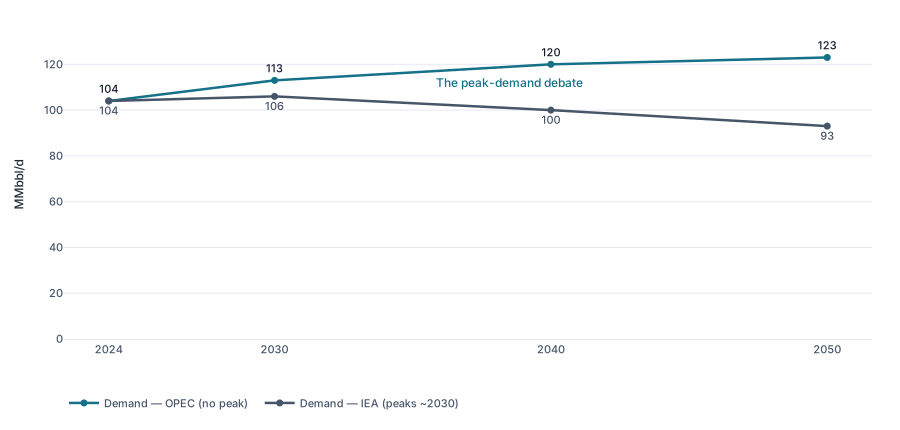
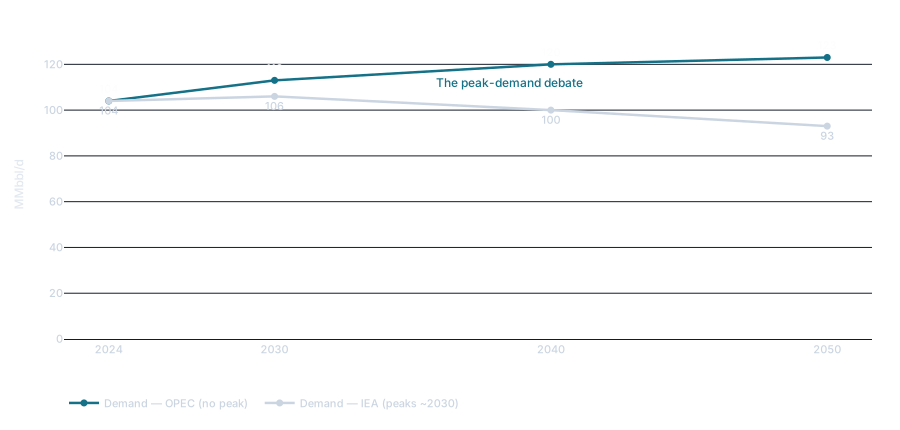
OPEC, in its 2025 World Oil Outlook to 2050, sees no peak: global demand rising from about 104 MMbbl/d in 2024 to ~113 in 2030, ~120 in 2040 and ~123 in 2050, led by road transport, aviation and petrochemicals in the developing world. The IEA is far more conservative — in its policy scenarios demand plateaus near 105–106 MMbbl/d around 2030 before flattening or falling as EVs and efficiency bite (even its Current Policies case reaches only ~105 by 2035 and ~113 by 2050, roughly where OPEC already sees 2030). The U.S. EIA sits between them. The gap — on the order of 10 MMbbl/d by 2030–2040 and ~30 by 2050 — is the difference between a world that electrifies transport quickly and one that does not, so the honest read is a range, not a point: demand most likely grinds higher into the 2030s, with the timing of any peak hinging on EV adoption, Chinese road fuel and petrochemicals.
5.2 Supply and the investment treadmill
Oil’s supply outlook is less about geology than reinvestment: because producing fields decline about 4–6% a year, the industry must add several MMbbl/d of new capacity every year just to hold output flat. Near-term, US shale has plateaued and responds to prices around a mid-$60s/bbl breakeven, while OPEC+ holds the world’s spare capacity (several MMbbl/d) and manages the balance through quotas — which is why oil rarely shows a lasting “supply gap”: supply follows demand, and the swing variables are the demand path above and OPEC+ cohesion (tested by the UAE’s 2026 quota exit). The real risks are two-sided: under-investment that leaves supply short in a higher-demand world, or stranded capacity if demand peaks early.
Table 30. Oil demand scenarios to 2050 (MMbbl/d)
| Forecast (source · scenario) | 2024 | 2030 | 2040 | 2050 |
|---|---|---|---|---|
| Demand — OPEC WOO 2025 (no peak) | 104 | 113 | 120 | 123 |
| Demand — IEA STEPS (peaks ~2030) | 104 | ~106 | ~100 | ~93 |
| Demand — IEA Current Policies | 104 | ~108 | — | ~113 |
Source: OPEC World Oil Outlook 2025 ; IEA — Oil 2025 and World Energy Outlook 2025; U.S. EIA International Energy Outlook . Figures are scenario projections, not measured data; MMbbl/d = million barrels per day.
Figure 11. Oil demand to 2050 — the peak debate (MMbbl/d)
Source: OPEC World Oil Outlook 2025 ; IEA — Oil 2025 , 2025. Scenario projections, not measured data.
5.3 Catalysts to watch
The structural questions that will shape the next decade are the timing of peak oil demand (the IEA’s ~2030 call), how fast petrochemicals offset declining transport-fuel demand, and OPEC+ cohesion after the UAE’s 2026 quota exit and whether other members follow. Near-term, the market watches OPEC+ meetings and the path of voluntary cuts, US shale’s response to prices around the mid-$60s breakeven, Chinese demand, and the trajectory of the dollar and global interest rates. Acute geopolitical flare-ups around the key chokepoints remain the largest source of short-term price risk, but they are episodic rather than structural.
Table 31. Key catalysts & watch-list
| Catalyst / theme | Timing | Why it matters | Watch |
|---|---|---|---|
| OPEC+ policy & cohesion | Recurring | Sets quota discipline | Production vs. quota |
| US shale response | Ongoing | Marginal global supply | Rig count, breakevens |
| Peak demand timing | ~2030 | Long-run terminal value | IEA/OPEC outlooks |
| Chokepoint security | Episodic | Short-term supply risk | Hormuz / Malacca flows |
Source: IEA Oil 2025 , OPEC , and the Dallas Fed Energy Survey . Forward-looking watch-list, not forecasts.
6. Summary
Oil remains the world’s most strategic commodity. It is a dual-purpose hydrocarbon — fuel for transport and feedstock for petrochemicals — whose value depends on quality (light/sweet vs. heavy/sour) and extraction type (conventional vs. unconventional shale). The price is best understood through averages — about $69/bbl Brent in 2025 and ~$81/bbl over five years — because spot prices swing violently, as the 2000–2025 history shows. Supply is concentrated: the US, Russia, and Saudi Arabia produce nearly 40% of crude, while the US and China consume a third of all liquids. The global market sits near balance year to year, with the US, Saudi Arabia, and Russia the great net exporters and China, India, and Japan the great importers — flows that funnel through the Strait of Hormuz and the Strait of Malacca. Crude is essentially never recycled, so depletion makes the market structurally tight; co-products like NGLs and associated gas shape well economics. OPEC (now eleven members after the UAE’s 2026 exit) and the wider OPEC+ group, led at the margin by Saudi spare capacity, coordinate supply, with price-driven US shale as the counterweight. The companies range from the NOC giant Saudi Aramco to the integrated majors and price-levered independents, screened on reserves, breakevens, and netbacks. Across the cycle, oil is pro-cyclical and a supply-shock/inflation hedge — strong in expansion and stagflation, weak in recession, inversely tied to the dollar — and its great concluded cycles (the 1970s shocks, 2008, 2014–16, 2020, 2022) all teach the same lesson: prices are set at the margin and move violently because supply and demand are both inelastic.
For the company-level data behind this picture — screening every oil & gas producer by reserves, breakeven, NPV, and valuation — explore Metal Pilot .
7. Vocabulary
Every specialised term used in this report, defined once at first use in the body, collected here for reference.
Table 32. Oil & gas vocabulary
| Term | Plain-language definition | Why it matters |
|---|---|---|
| API gravity | Density scale; high = light crude | Light crude yields more high-value fuels → higher price |
| Sweet / sour | Low / high sulfur content | Sour crude is discounted and costlier to refine |
| Conventional oil | Crude that flows from a permeable reservoir with standard methods | The traditional, low-cost model (e.g. Ghawar) |
| Unconventional oil | Oil trapped in tight rock or sands, needing fracking or mining | Shale & oil sands; higher cost, more price-elastic |
| Upstream / midstream / downstream | Production / transport & storage / refining & marketing | Defines a company’s business model and price exposure |
| 1P / 2P / 3P | Proved / proved+probable / proved+probable+possible reserves | The confidence ladder for reserve estimates |
| PDP / PUD | Proved developed producing / proved undeveloped | Distinguishes flowing barrels from future drilling |
| Decline rate | Annual % fall in a well’s output | Shale declines fast (~30–70% yr 1), requiring constant drilling |
| Netback | Realized price minus all costs to deliver | The producer’s effective margin per barrel |
| Breakeven | Price needed to profitably drill/operate | Sets the floor under supply (US shale ≈ $65/bbl new wells) |
| NPV10 / PDP NPV10 | Net present value of future cash flows at a 10% discount | The standard way reserves are valued |
| Spare capacity | Output that can be brought online quickly and sustained | OPEC’s (mainly Saudi) tool to manage prices |
| Associated gas / NGLs | Gas produced with oil / liquids (ethane, propane, butane) | Co-products that shape well economics |
| Crack spread | Margin between crude cost and product value | Drives refiner profitability |
| Realized price | The price a company is actually paid per barrel sold | Differs from the benchmark by quality, location and contract terms |
| Differential | The premium or discount to a benchmark in a sales formula | Where quality and location are priced (e.g. WCS ≈ $11/bbl under WTI) |
| Official selling price (OSP) | A monthly differential published by an NOC per grade and region | Aramco’s OSP is read as a market-share vs. price signal |
| Term vs. spot | Annual formula-priced contract vs. single negotiated cargo | Most crude moves on term; spot is the flexible margin |
| Take-or-pay / firm transportation | Contracted capacity payable whether or not volumes flow | Buys premium market access; becomes a fixed cost in downturns |
| LNG | Liquefied natural gas (gas chilled for shipping) | Makes gas a globally traded commodity |
| Contango / backwardation | Forward curve up-sloping / down-sloping | Signals oversupply / tightness |
| Total liquids vs. crude | All petroleum (incl. NGLs, biofuels) vs. crude only | Demand (~103) is total liquids; crude output is narrower (~83) |
| Strategic Petroleum Reserve (SPR) | Government-held emergency crude stockpile, released during supply disruptions | A finite supply buffer and policy lever; the US SPR is the best-known |
Source: SPE Petroleum Resources Management System (reserve terms) and U.S. EIA / IEA Oil 2025 glossaries.
8. Sources, methodology & disclaimer
8.1 Sources, methodology & data vintage
Figures were drawn from agency and industry data and cross-checked where possible; all quantitative claims cite primary agency sources (EIA, IEA, EI, OPEC) rather than secondary aggregators. Prices are averages, not spot quotes: Brent annual averages are from the EIA/Energy Institute series (2024 ≈ $80.5, 2025 ≈ $69.1), and multi-year averages are computed from that series. Production figures are Jan–Nov 2025 annualized averages (crude + condensate); reserves are year-end 2024 (OPEC Annual Statistical Bulletin 2025). Demand, supply, and balance series are approximate, total-liquids basis, rounded from IEA/EI estimates and intended as chart-ready inputs rather than precise accounts. Regime and correlation statements are qualitative and historical, not forecasts. Data as of 13 June 2026; refresh annually after the Energy Institute Statistical Review and the IEA Oil reports.
Key sources:
- U.S. EIA — Short-Term Energy Outlook , Europe Brent spot price (annual) , international production & trade data , World Oil Transit Chokepoints , and SPR crude oil stocks
- U.S. DOE — SPR Quick Facts
- IEA — Oil 2025 , Oil Market Report (Dec 2025) , and oil stocks of IEA countries
- Energy Institute — Statistical Review of World Energy 2025
- OPEC — Member Countries and the Annual Statistical Bulletin (reserves)
- Federal Reserve Bank of Dallas — Dallas Fed Energy Survey
- Argus Media — Argus Sour Crude Index (ASCI) methodology (formula pricing and OSP benchmarks)
- Alberta Energy Regulator — ST98 crude oil prices (WCS–WTI differential)
- Vitol — 2025 volumes and review (physical trading volumes)
8.2 Disclaimer & disclosure
This report is for informational and educational purposes only and is not investment advice, nor an offer or solicitation to buy or sell any security or commodity. It was prepared with the assistance of AI; figures were sourced from public agency and industry data and reviewed, but readers should independently verify any number before relying on it. Oil, gas, and energy-equity prices are highly volatile; all figures are estimates as of the stated dates and will change, and historical performance and correlations are not indicative of future results. Do your own research and consult a licensed financial advisor before making investment decisions. The author holds no positions relevant to this report at the time of writing.